

August 24, 2026
The gold price rose 6.4% to US$4,662/oz, a weekly percentage gain towards the highs of recent decades, and the second huge jump after a 7.2% rise two weeks ago, with global financial risk spiking and the US intervening in bond and currency markets.
TSX/TSXV mining sector equity investment has risen considerably in 2026, especially driven by the gold sector, even with a decline in the metal price for much of this year, with the TSXV juniors actually seeing higher capital raised than TSX mining.
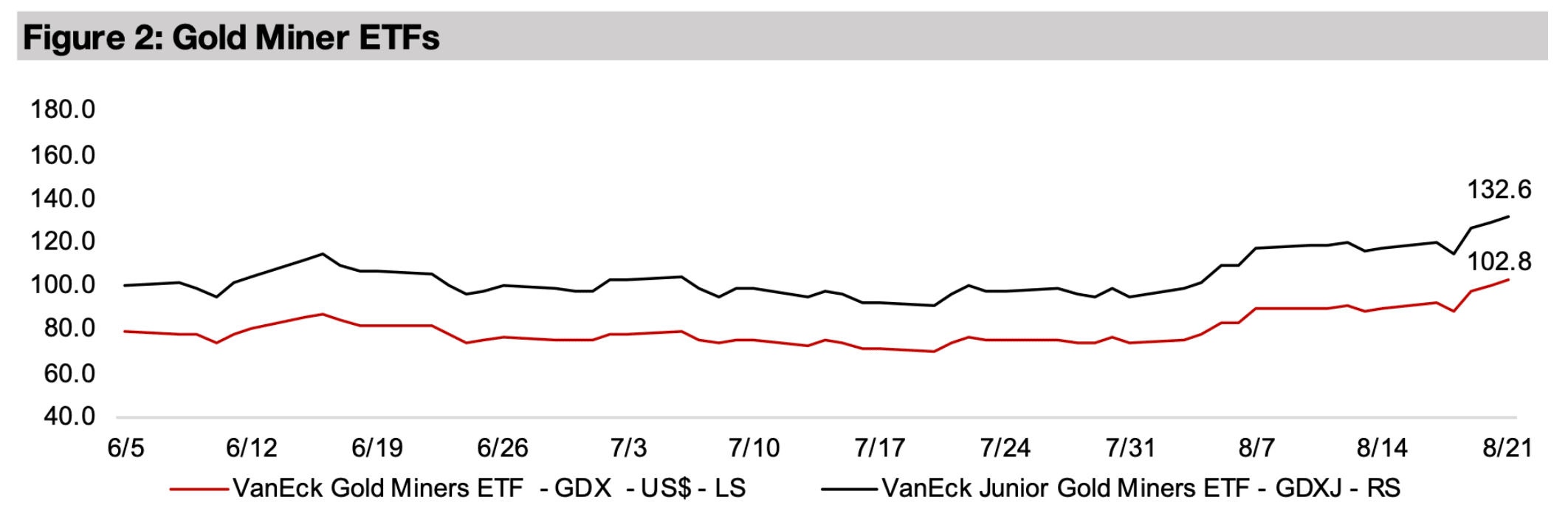
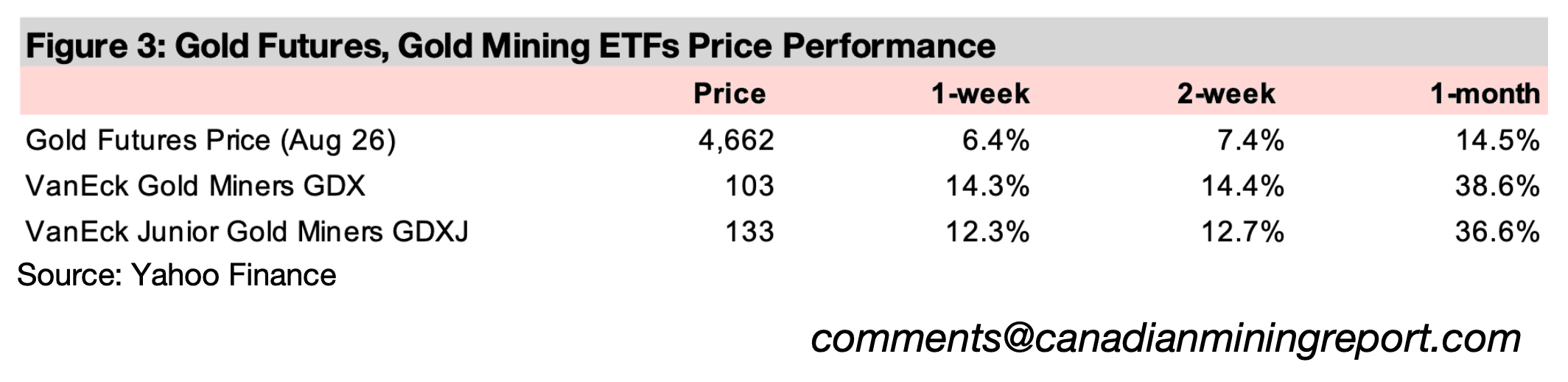
The gold boom resumed after a pause last week, with the GDX up 14.3% and the GDXJ rising 12.3%, continuing a major rebound over the past three weeks after a stagnation at the lows for the year through most of July 2026.


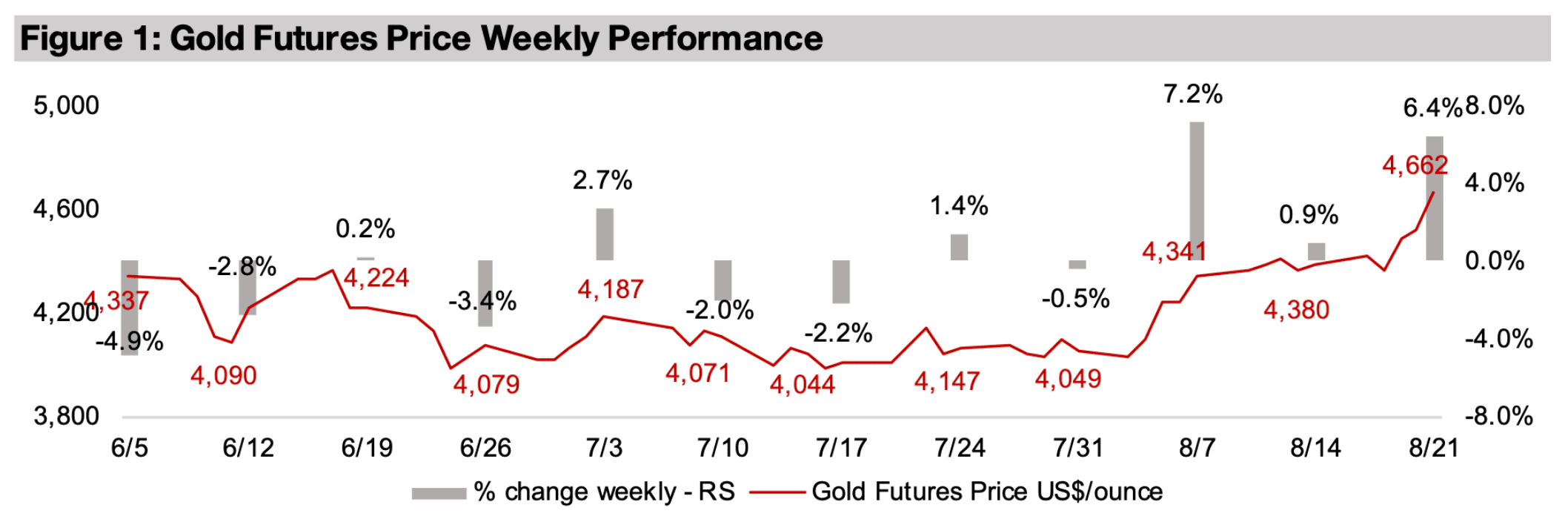
The gold price rose another 6.4% to US$4,662/oz, which is towards the highs for
historical percentage weekly gains for the metal, continuing a dramatic rebound that
started with a 7.2% increase two weeks ago, one of the highest in two decades, after
a relative pause last week given only a 0.9% rise. This appears to have been driven
by the US intervention in bond markets this week, the third major sign over the past
month of widening global economic issues, following major US purchases of the Yen
in late July 2026 and weak US employment data in the first week of August 2026.
This is in addition to rising concern in recent months of the sustainability of the AI
boom which is still driving much of global economic growth and the rise in equity
markets. There has also recently been a surge in private credit defaults, which while
a relatively small proportion of debt markets, is still feared to have a potential spillover
effect, especially with the sector still opaque with limited information available. There
is also still a lack of geopolitical clarity, especially regarding the conflict in the Middle
East, which has resulted in still high and rising oil prices through August.
Only a month ago, the market consensus was that gold would be under pressure
from high inflation from rising oil prices and strong US employment, which would
drive a rate hike and boost real yields and the US$, which both tend to move inversely
to the metal price. However, this has shifted substantially in recent weeks as US
employment data slumped and the country’s support for the Yen and bond markets
suddenly raised the much greater risk of global financial instability. This substantially
reduced the probability of US rate hikes, with the US intervention in the bond markets
implying quantitative easing, and not tightening, as had previously been expected.
For the US bond market intervention the Treasury purchased longer-duration bonds,
increasing demand and driving up their price, and therefore reducing yields. This was
intended to lower surging long-term borrowing costs for the country, with the yield
on 30-year bonds having peaked at 5.33% on August 18, 2026. While these
purchases did lower the US 30-year bond yield to 5.18% briefly by August 20, 2026,
it has risen since to 5.24%, showing that the market has resumed some selling of US
longer-term debt.
This move is also related to the earlier move to support the Yen, as Japan is the
largest foreign holder of US debt, and has been under pressure to sell these bonds
to support its currency, which has plunged versus dollar over the past several years.
The US targeted purchasing US$5bn or more Yen, which did drive an appreciation to
JPY157.6/US$ by July 27, 2026 from a peak of JPY163.8/US$ on July 20, 2026,
although it subsequently reversed some of the gain, declining to JPY158.9/US$. That
both the bond and Yen pulled back after initially strengthening shows that global
markets still remain cautious that either of the moves can be sustained based on
fundamentals and without further potential intervention.
The Yen has also been an important funding source in recent decades, with global
markets borrowing at the country’s near zero interest rates and investing at higher
rates outside the country, generating a substantial spread. However, with Japan’s
rates rising over the past two years, this spread has contracted, driving some
unwinding of this global carry trade, which could decrease a key source of liquidity
for the rise in equities, especially AI-led tech. A strengthening Yen further hits this
trade, as repaying borrowings becomes more expensive as the currency rises.
With the bond market intervention results mixed and possibly indicating some
underlying fragility in the financial system, equities declined this week, with the S&P
500 down -1.5%, the Nasdaq dropping -2.2% and the Russell 2000 declining -1.4%.
The gold stocks far outperformed equities market on the rise in the metal price and
as markets moved heavily into safe havens, with the GDX up 14.3% and GDXJ
gaining 12.3%.
The spike in the gold price raises the issue of whether it has again gone too far too
fast, as in late 2025 and early 2026. However, there were actually limited fundamental
changes during this previous surge, with the main driver being the expectation prior
to the Middle East war that a global rate cutting cycle would continue through 2026.
While this did imply a rising global money supply, the key underlying driver for gold,
it was well known to the market for over a year at the time and likely largely priced in
by the end of 2025. However, the price continued to spike to its highs in January
2026 and nearly regained this level in February 2026 before the subsequent decline.
There have been substantial changes in fundamentals driving the current rebound so
far, and the metal also could be reversing a degree of undervaluation after the plunge
from March 2026 to July 2026. A key indicator of whether the gold trade has started
to attract more short-term speculation is inflows into the largest gold price ETF, GLD.
For the first two weeks of August, which included the huge initial rebound in gold,
inflows were not particularly high at US$1.4bn and US$0.8bn. However, they surged
to US$3.4 bn over the past week, near previous highs of US$3.7bn in third week of
February 2026 and US$4.1bn in the second week of October 2025. This suggests
that if another retail bubble is forming, it only gained significant momentum this week.
TSX/TSXV aggregate mining equity investment has still risen significantly this year, even with a decline in the gold price overall, with the metal either in a slump, from March 2026 to June 2026, or stagnation, in July 2026, for much of the year apart from volatile spikes in January and February 2026 and the jump over the past two weeks. The sector is still likely the largest driver of capital raising for mining on both indices, and we estimate that gold companies are about 50% of the TSXV market cap, with copper and other base metals the second largest sector.
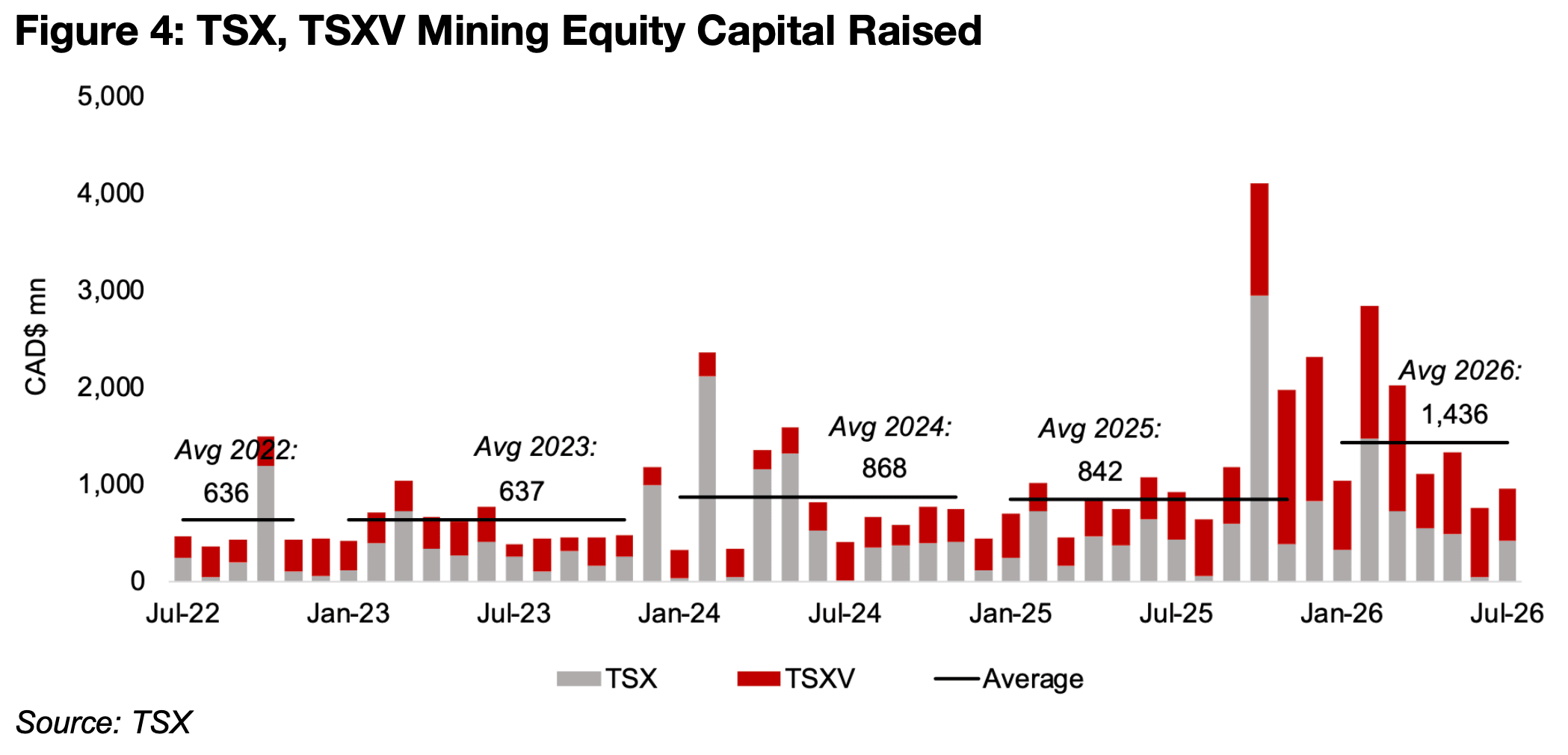
The average monthly equity capital raised for TSX/TSXV combined has been CAD$1.4bn in 2026, up 70% yoy from CAD$842mn in 2025, which was similar to the CAD$868mn in 2024, and up from CAD$637mn and CAD$636mn in 2023 and 2022 (Figure 4). While the TSX was the major contributor in February 2026, the TSXV led investment in the other months this year, showing that the markets are still heavily funding juniors. The only clear weakness this year was TSX mining investment for June 2026 at just CAD$46mn, although there have been several months near or even below this level in recent years, with CAD$57mn in August 2025, CAD$9mn in July 2024 and CAD$41mn in both March 2024 and January 2024. The TSX tends towards fewer deals, at around only ten on average per month for 2026, but with a higher average value, of CAD$54mn, and some months none of these major deals are completed.
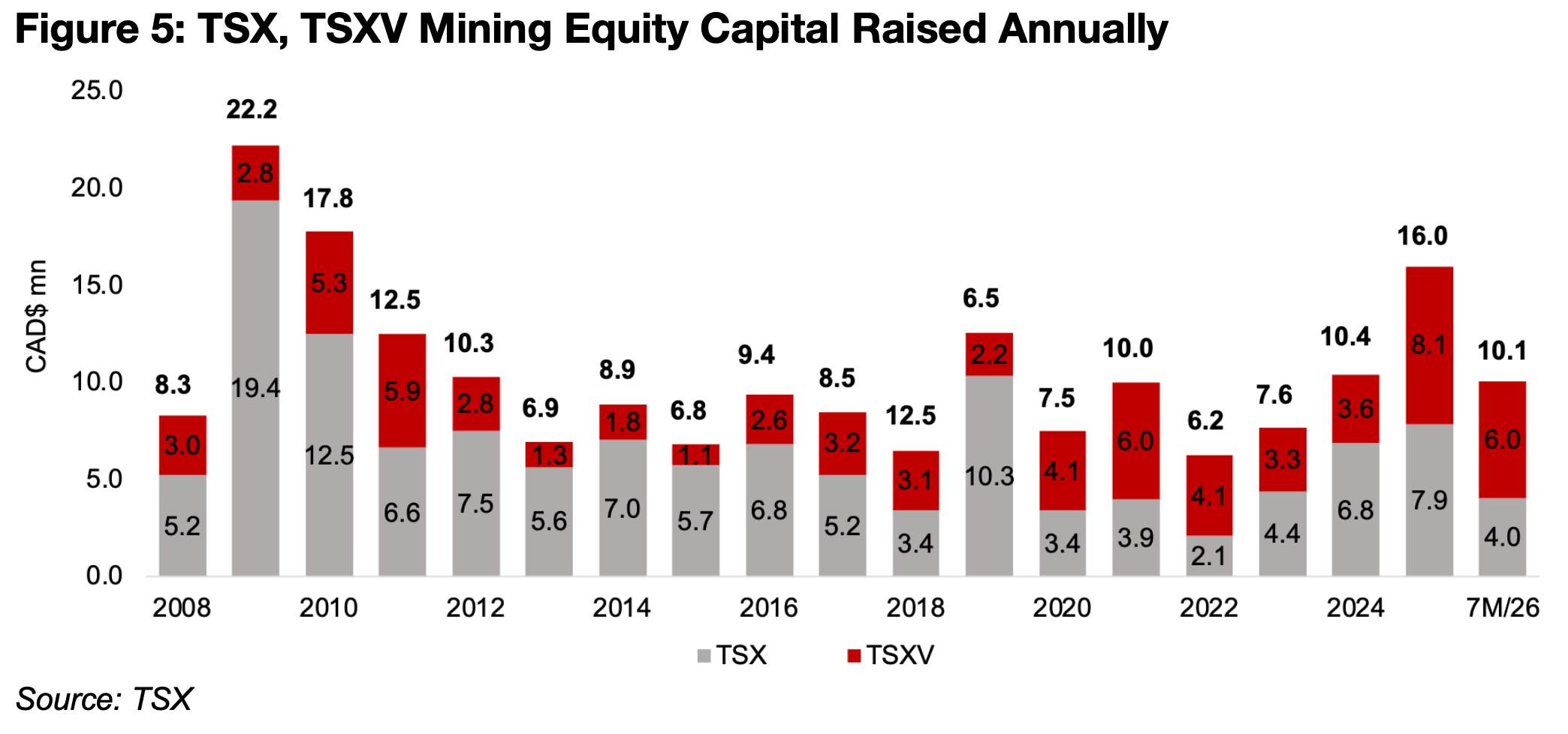
The TSX and TSXV combined mining investment for the first seven months of 2026
is CAD$10.1bn, already near the 2024 level CAD$10.4bn. If it maintains this monthly
average, it could reach CAD$17.3bn, well above the CAD$16.0bn in 2025 (Figure 5).
This would be the highest since the CAD$17.8bn in 2010, with the previous peak at
CAD$22.2bn, although adjusted for inflation, the equity capital raised over the past
two years could actually be above these previous highs. One major change over the
past two years has been the shift towards the juniors on the TSXV, which comprised
51% of total equity capital raised in 2025 and 50% over 7M/26 of the total, versus
just 13% and 30% in 2009 and 2010.
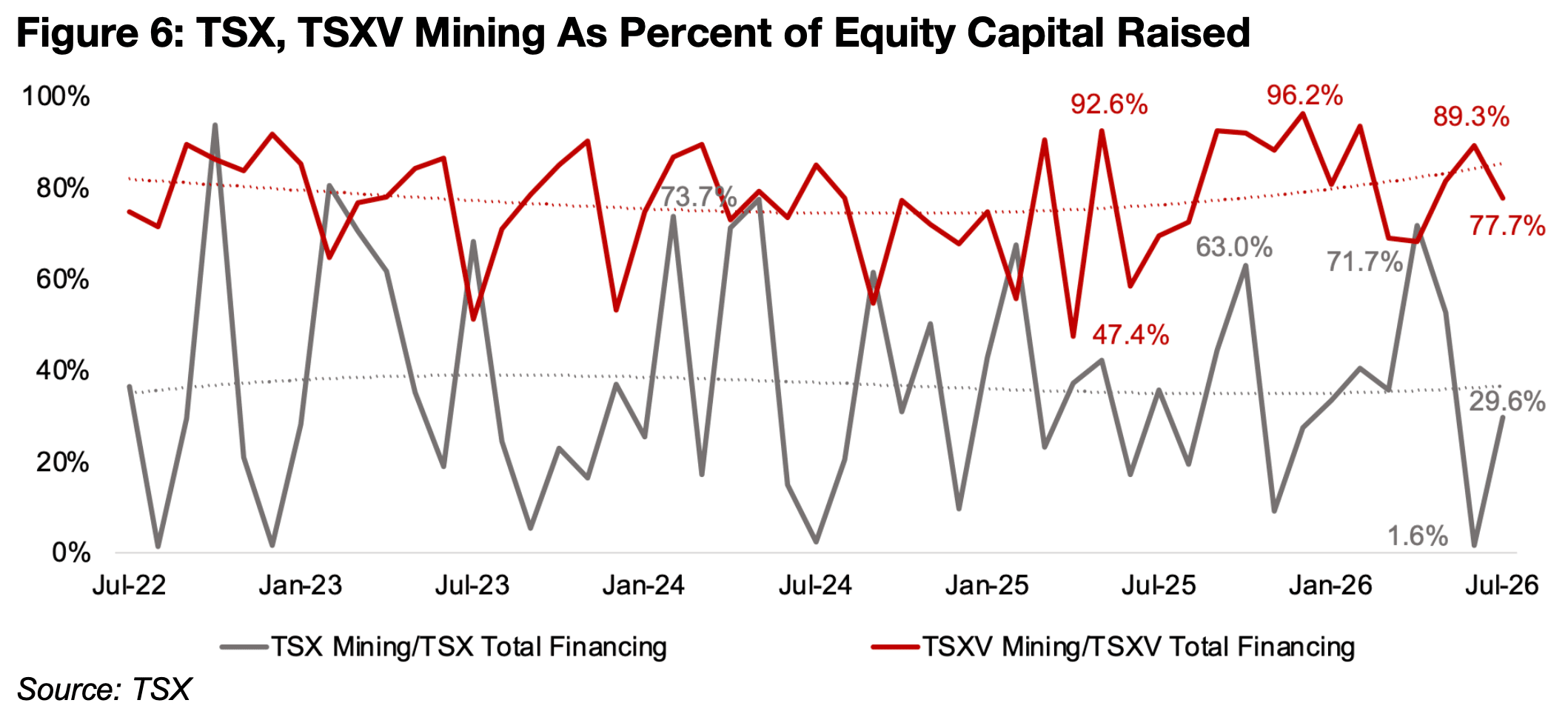
Even with the pullback in gold this year, mining has still continued to dominate the
equity capital raised for the TSXV and has also been a major contributor for the TSX.
In July 2026, mining was 77.7% of the total and 89.3% in June 2026, and an average
79.7% for the TSXV over 2026, versus the 80.8% average for 2025, which is
moderately higher than the 76.1% of 2024 and 75.4% of 2023 (Figure 6). Over the
past two years the sector peaked at 96.2% in December 2025 and 92.6% in May
2025, comprising almost all of the equity capital raised on the index. On the TSX the
mining sector was 29.6% of the total equity capital raised in July 2026, up from just
1.6% in June 2026 and down from the recent peak of 71.7% in April 2026.
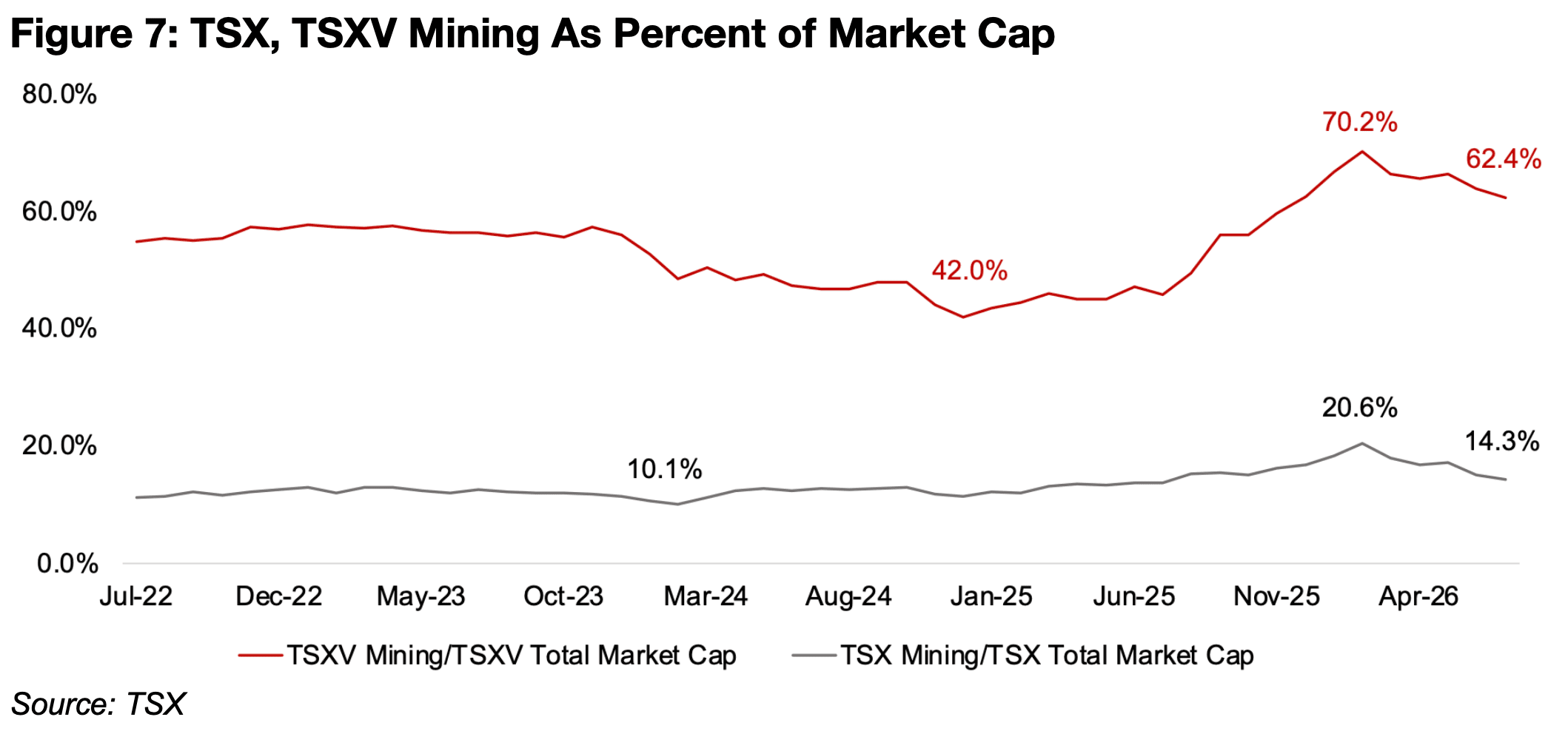
This correlates with the higher proportion of the TSXV market cap in the mining sector, at 62.4% (Figure 7). While this is down from a recent peak of 70.2%, it is still high versus an average of just 45.6% from July 2024 to July 2025. The much larger TSX is more diversified, with the mining sector at just 14.3% of the total market cap, down from a peak of 20.6%. This shows that the mining sector’s share of equity capital raised is well above its proportion of the market cap, as it has particularly strong ongoing capital requirements versus many other major sectors.
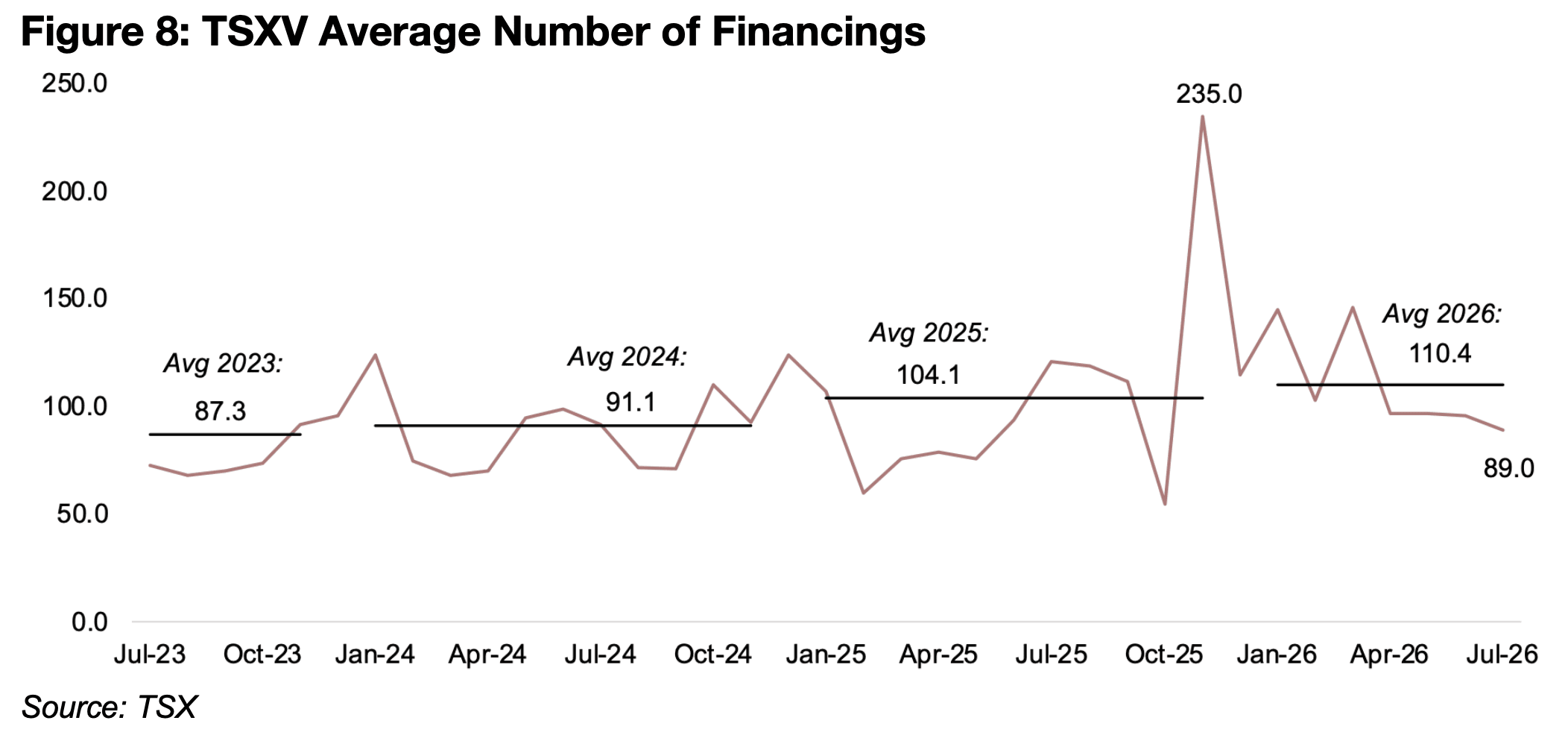
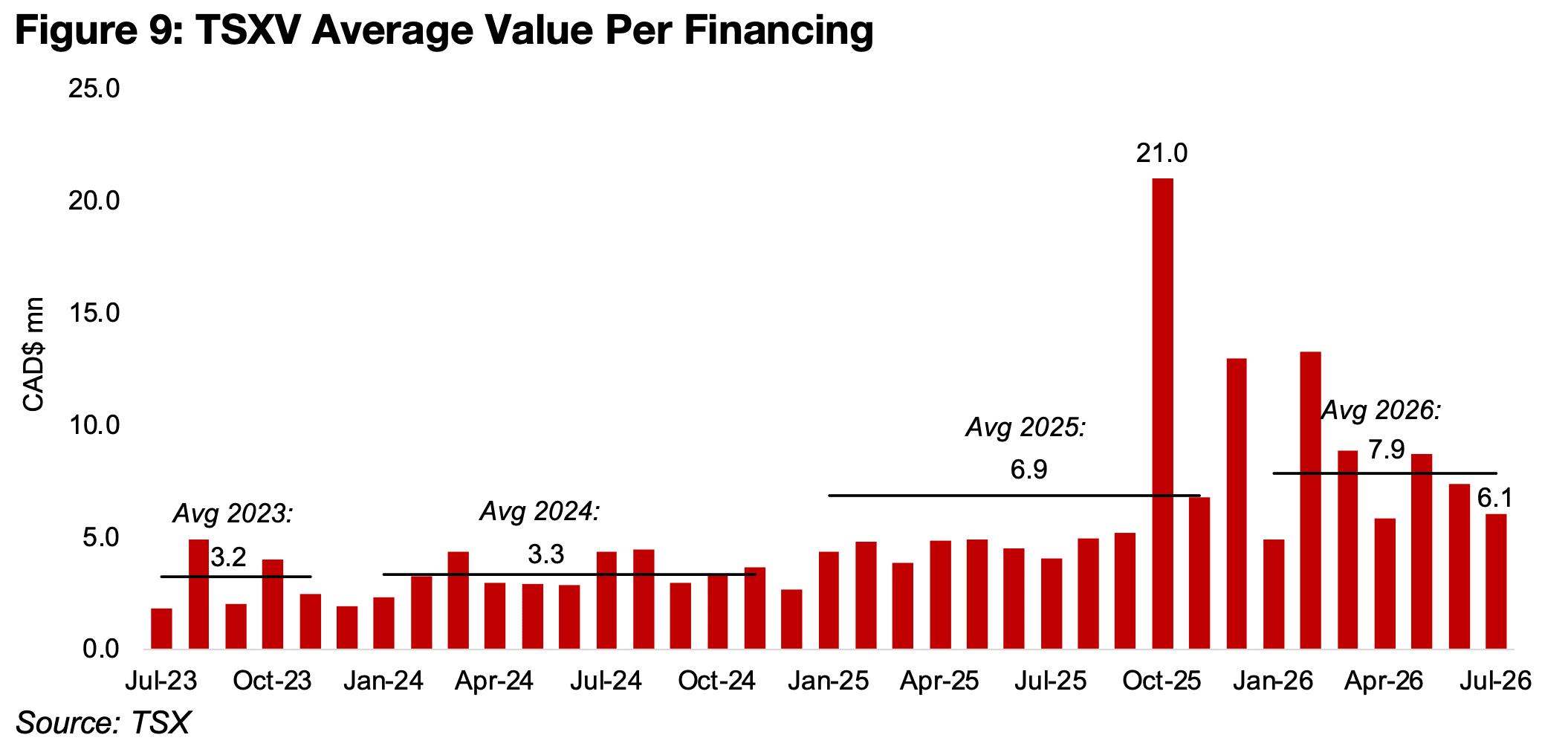
The relatively low number of TSX deals contrasts with a much higher average for the TSXV, at an average 110 per month in 2026 (Figure 8). The total deals has declined this year to 89.0 in July 2026 from a peak of 235 in November 2025, well before the major jump in the gold price (Figure 9). However, the index has a much lower average value per transaction, at just CAD$7.9mn. This is up from CAD$6.9mn in 2025 and has doubled from just CAD$3.3mn and CAD$3.2mn, which is inline with a far higher gold price driving a significant increase in valuations in the sector. The average deal value in July 2026 was CAD$6.1mn, down from a peak for the year of CAD$13.3mn in February 2026, with the previous highs at CAD$21.0mn in November 2025.
Both the TSX and TSXV equity capital raised have not showed any indication of major issues with the sector getting funding, even given the major pullback in the gold price. While short-term speculators from December 2025 and January 2026 may have been hit, and sentiment dampened on the gold sector for the broader market, longer-term providers of capital continued to invest substantially in the sector throughout the downturn. As shown by the Q2/26 results, gold price levels during this period were still far more than enough to generate wide margins and if just current metal price levels are sustained for the rest of year, profitability will remain very high, and could encourage continued investment into the sector.
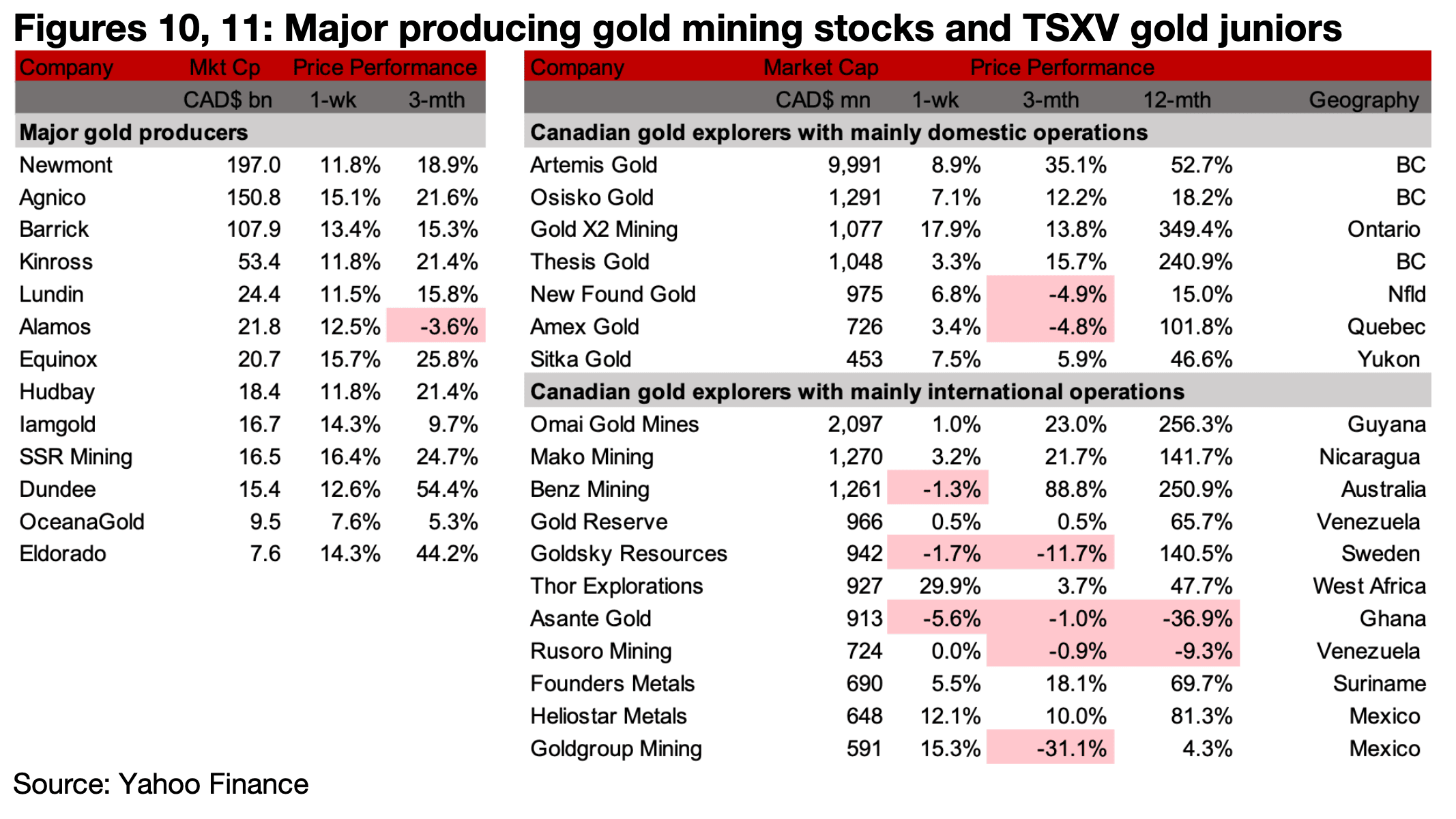
The major producers all rose and most of the TSXV gold gained on the jump in the
metal price (Figures 10, 11). For the TSXV gold companies operating mainly
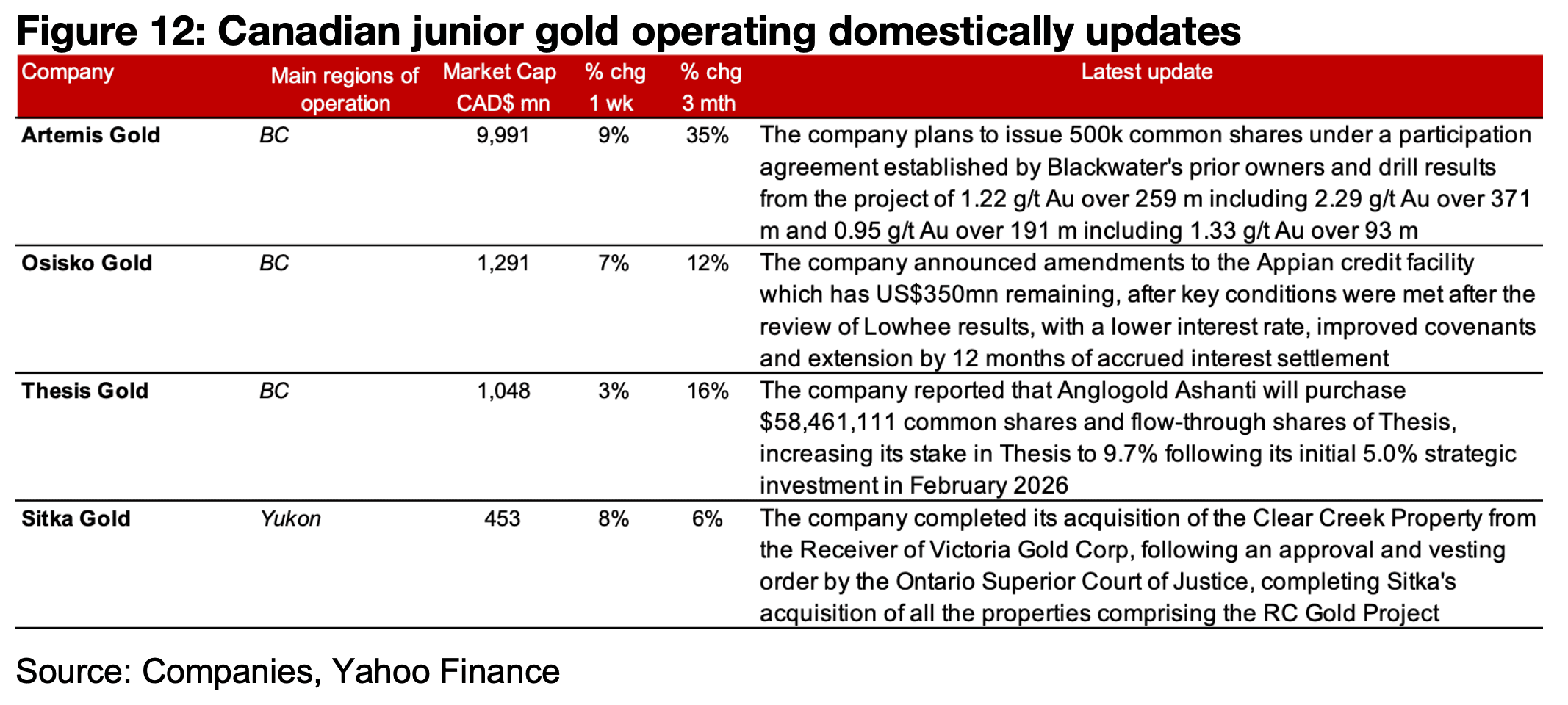
domestically, Artemis reported plans to issue shares under a participation agreement
and drill results from Blackwater, Osisko announced amendments improving the
terms of its Appian credit facility, Thesis reported that Anglogold Ashanti will
purchase $58.5mn of the company increasing its strategic stake to 9.7%, and Sitka
completed its acquisition of the Clear Creek Property, with it now entirely owning all
the properties comprising the RC Gold project (Figure 12).
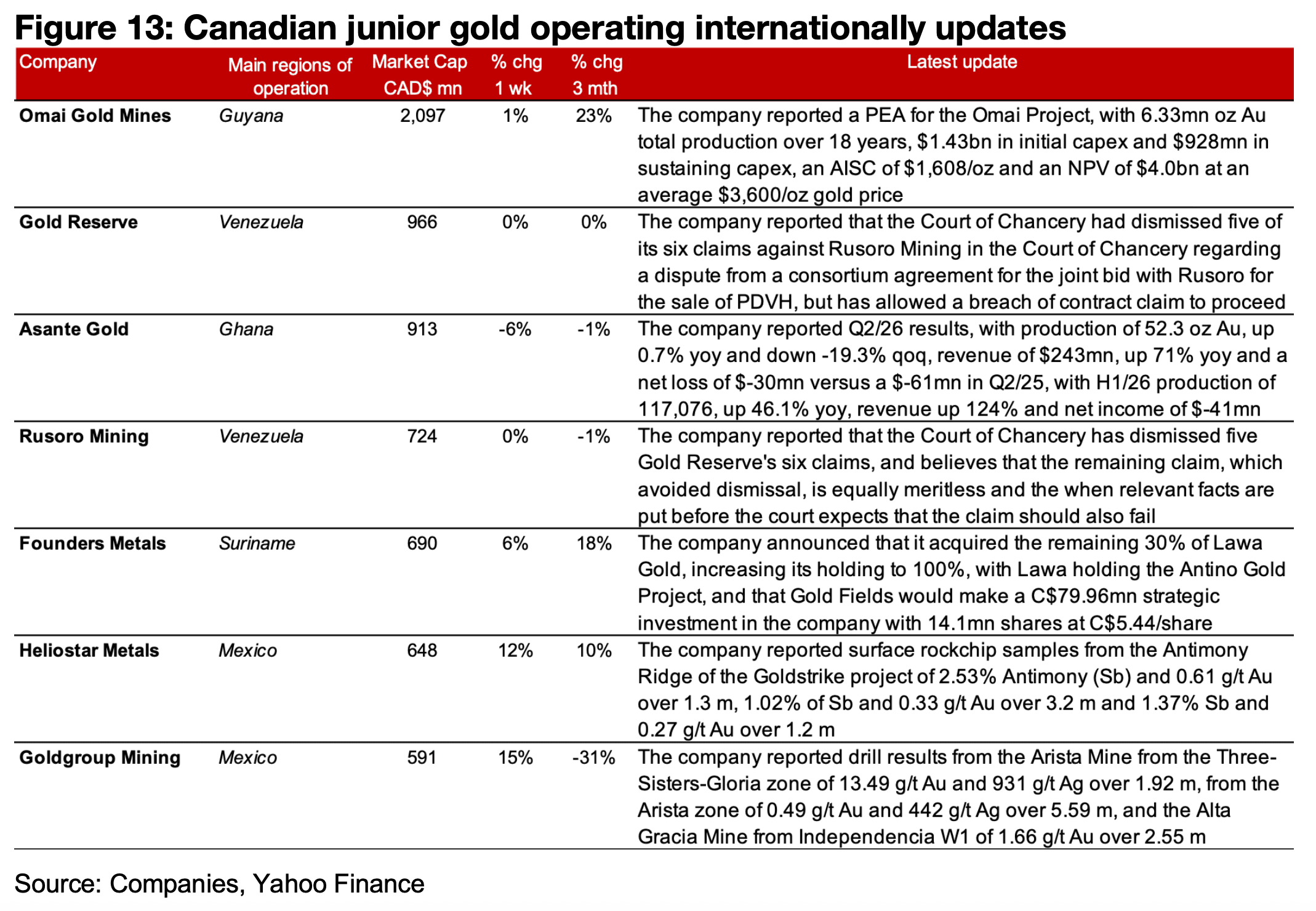
For the companies operating mainly internationally, Omai gold reported a PEA for the
Omai project, Gold Reserve and Rusoro Mining announced updates on their legal
processes, Asante reported Q2/26 results, Founders acquired another 30% of Lawa,
Heliostar announced rockchip samples from Antimony Ridge at Goldstrike and Gold
Group reported drill results from the Arista and Alta Gracia mines (Figure 13).
Disclaimer: This report is for informational use only and should not be used an alternative to the financial and legal advice of a qualified professional in business planning and investment. We do not represent that forecasts in this report will lead to a specific outcome or result, and are not liable in the event of any business action taken in whole or in part as a result of the contents of this report.
Author
Ben McGregor authors the Weekly Roundup at CanadianMiningReport.com, providing sharp analysis of the metals and mining sector. With a talent for spotting trends, Ben distills complex market shifts into clear, engaging insights on TSXV junior miners. His weekly updates cover gold, copper, uranium, and more, blending data-driven perspectives with a knack for identifying opportunities. A vital resource for investors, Ben’s work navigates the dynamic junior mining landscape with precision.