

September 07, 2026
The gold price was almost exactly flat at US$4,477/oz as US jobs data was mixed and the Fed’s Waller indicated that US rates should be maintained at its meeting this month, offsetting the recent hawkish tone of the Chairman.
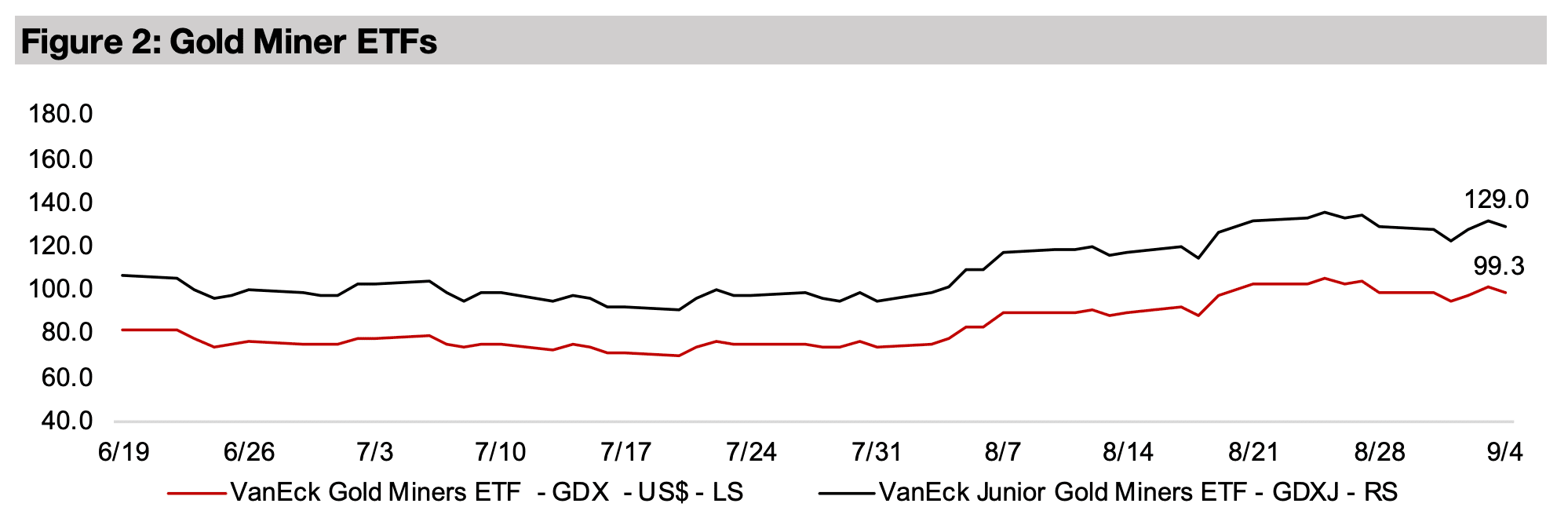
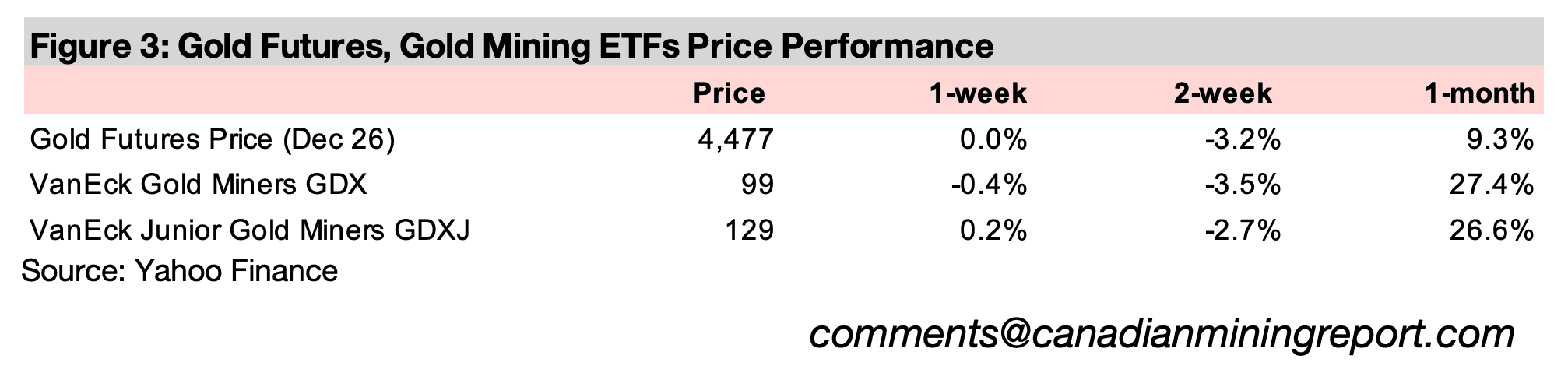
The gold stocks were muted along with the metal price, with the GDX down -0.4% and the GDXJ up 2.9%, while equities were also muted, with the S&P 500 up 0.3%, the Nasdaq rising 0.6% and the Russell 2000 small cap index gaining 0.3%.


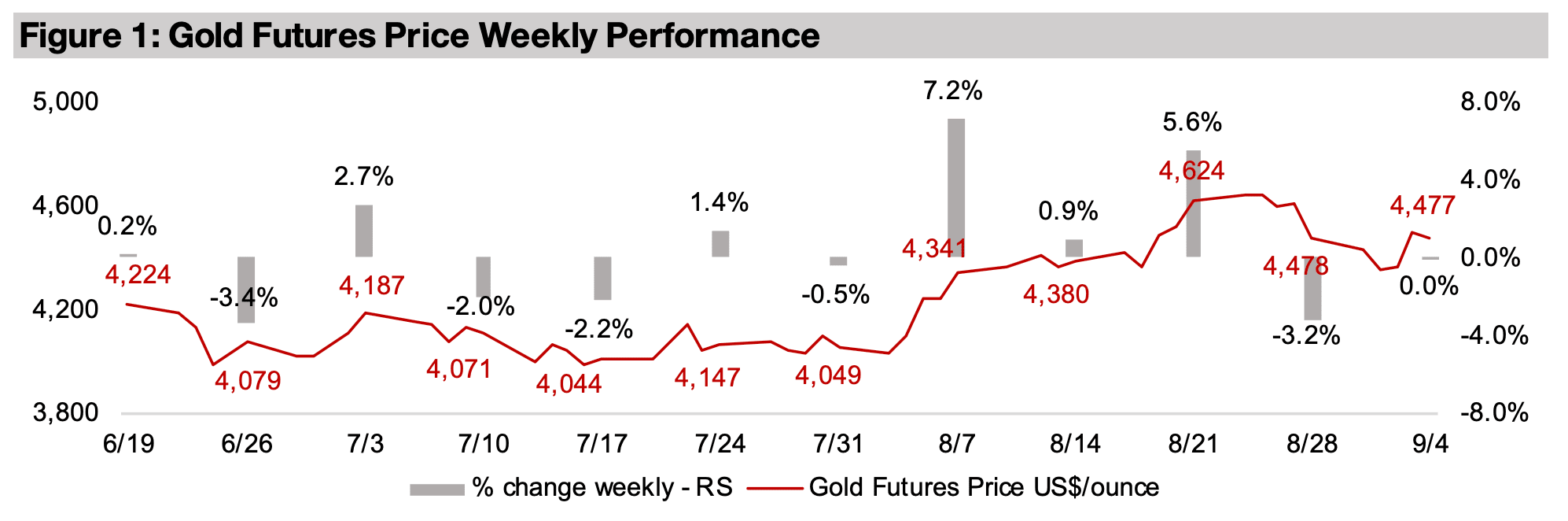
The gold price was almost exactly flat at US$4,477/oz, calming after considerable
volatility over the past month. There was first a surge in early August 2026 as major
interventions in the bond and currency markets by the US Treasury increased
concerns over financial stability. However, there was then a pullback after the
hawkish tone of the Fed Chairman’s speech at Jackson Hole, the first to clearly
outline his policy stance since he was appointed in May 2026. This was offset
somewhat this week by a more dovish stance taken by the Fed’s Waller this week,
commenting that rates should be left flat at the September 2026 meeting.
The other major economic news released was US jobs data which showed a mixed
picture and did not seem to indicate clear pressure on the Fed in either the direction
of maintaining or hiking rates. The US ADP payrolls in August 2026 increased by 38k,
moderately below the consensus estimates for 47k and down from 46k in July 2026,
but US nonfarm payrolls jumped 162k, far ahead of 53k market expectation, and well
up from just 23k in July 2026. The equities market were also relatively muted, with
the S&P 500 up 0.3%, Nasdaq gaining 0.6% and Russell 2000 small cap index adding
0.3%. The gold stocks were quite flat along with the metal price, especially in contrast
to the huge weekly moves in August 2026, with the GDX down -0.4% and GDXJ up
0.2%.
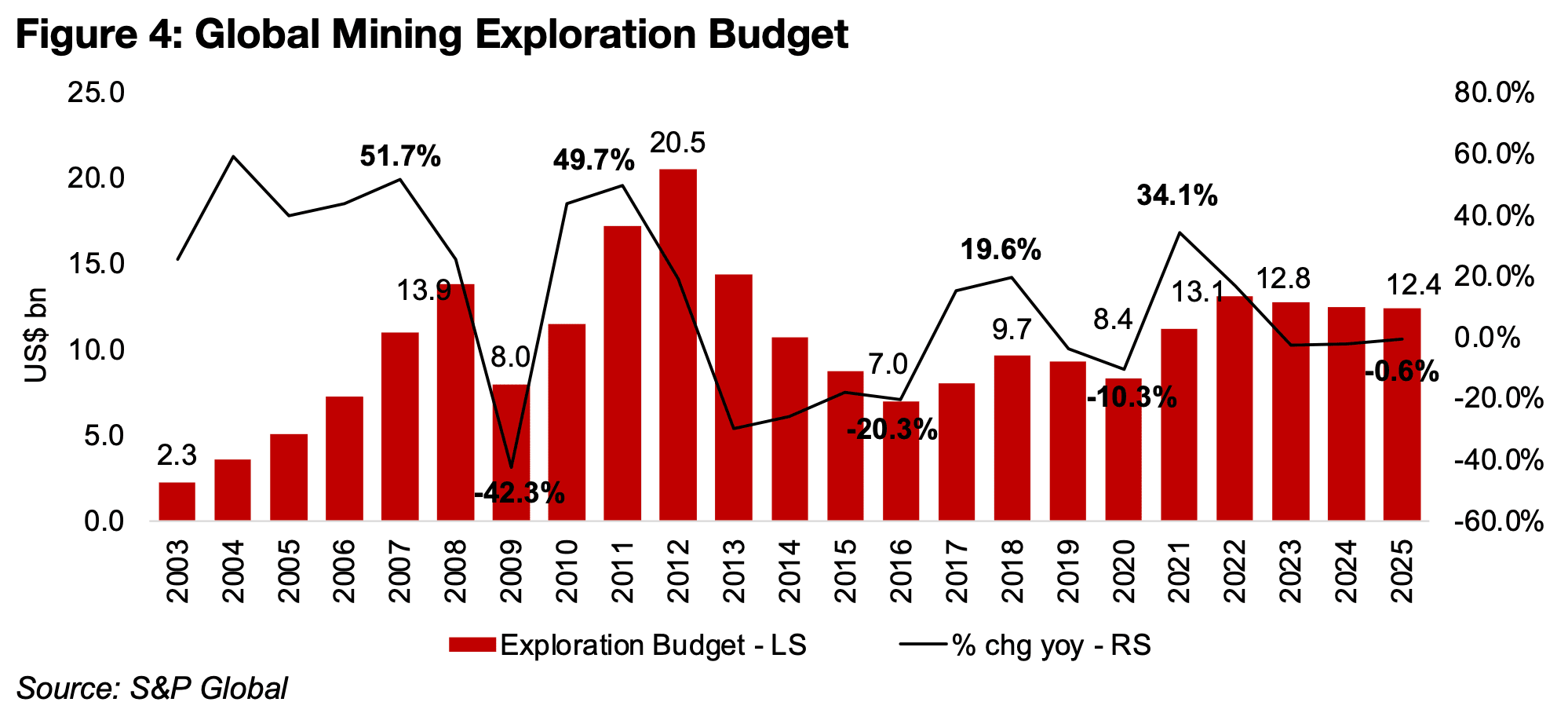
Global mining exploration investment has remained strong this year, with Canada one of the leaders in the sector. The global mining exploration budgets reported by S&P Global were US$12.4bn in 2025, and have held above US$12.0bn from 2022, edging down from recent highs of US$13.8bn in 2022 (Figure 4). While this is up from under US$10.bn from 2015-2020, it is still well below the US$20.5bn highs of 2012.
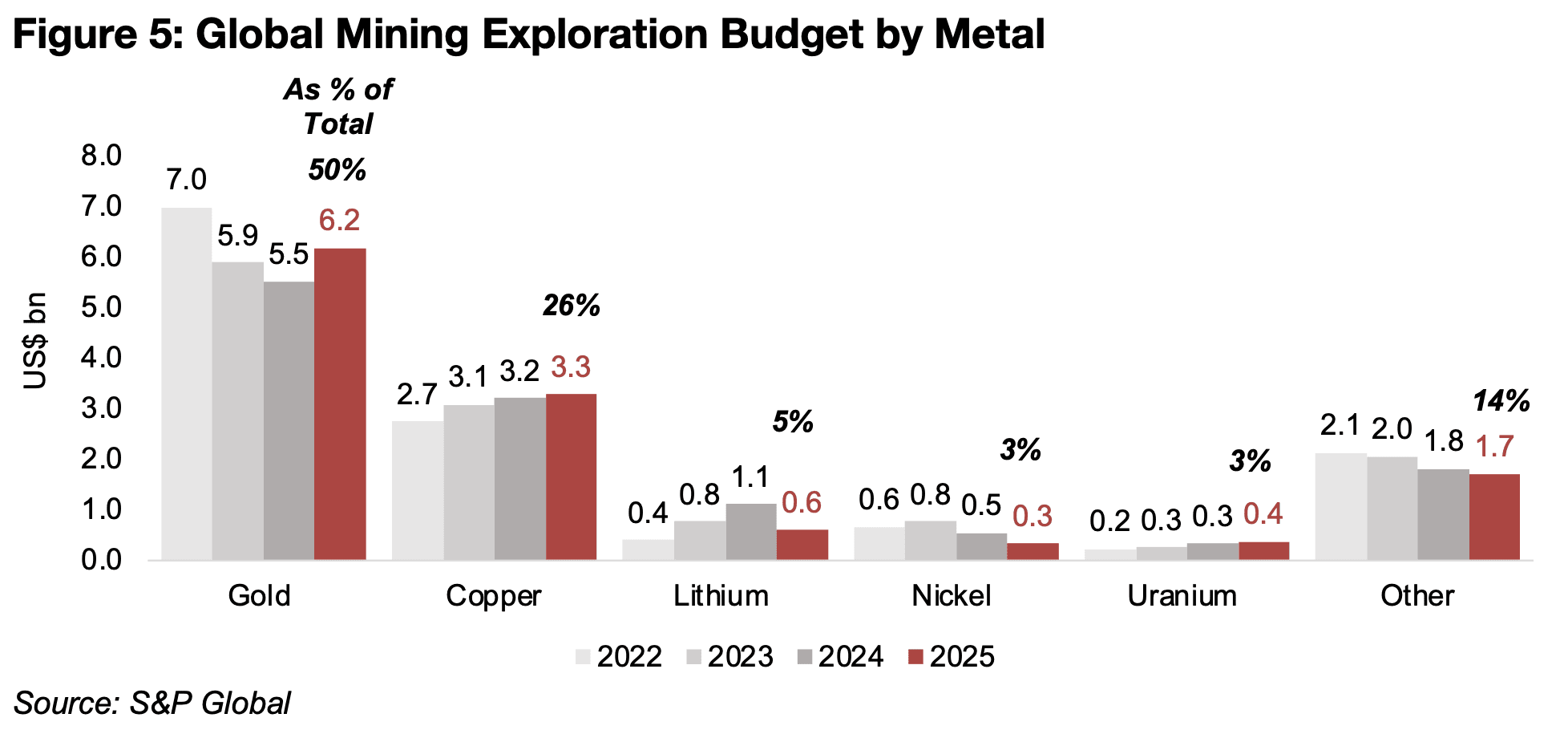
The gold sector has continued to see the largest exploration budgets in recent years, rising to US$6.2bn in 2025, or 50% of the total, from US$5.5bn in 2024, although this is down from US$7.0bn in 2022. Copper exploration budgets were about half this level in 2025, at US$3.3bn, or 26%, but have seen a consistent increase from US$2.7bn in 2022 (Figure 5). The budgets for other major metals are relatively small, with lithium, nickel and uranium at US$0.6bn, US$0.3bn and US$0.4bn in 2025, or 5%, 3% and 3% of the total, with all other metals at US$1.7bn, or 14% of the total.
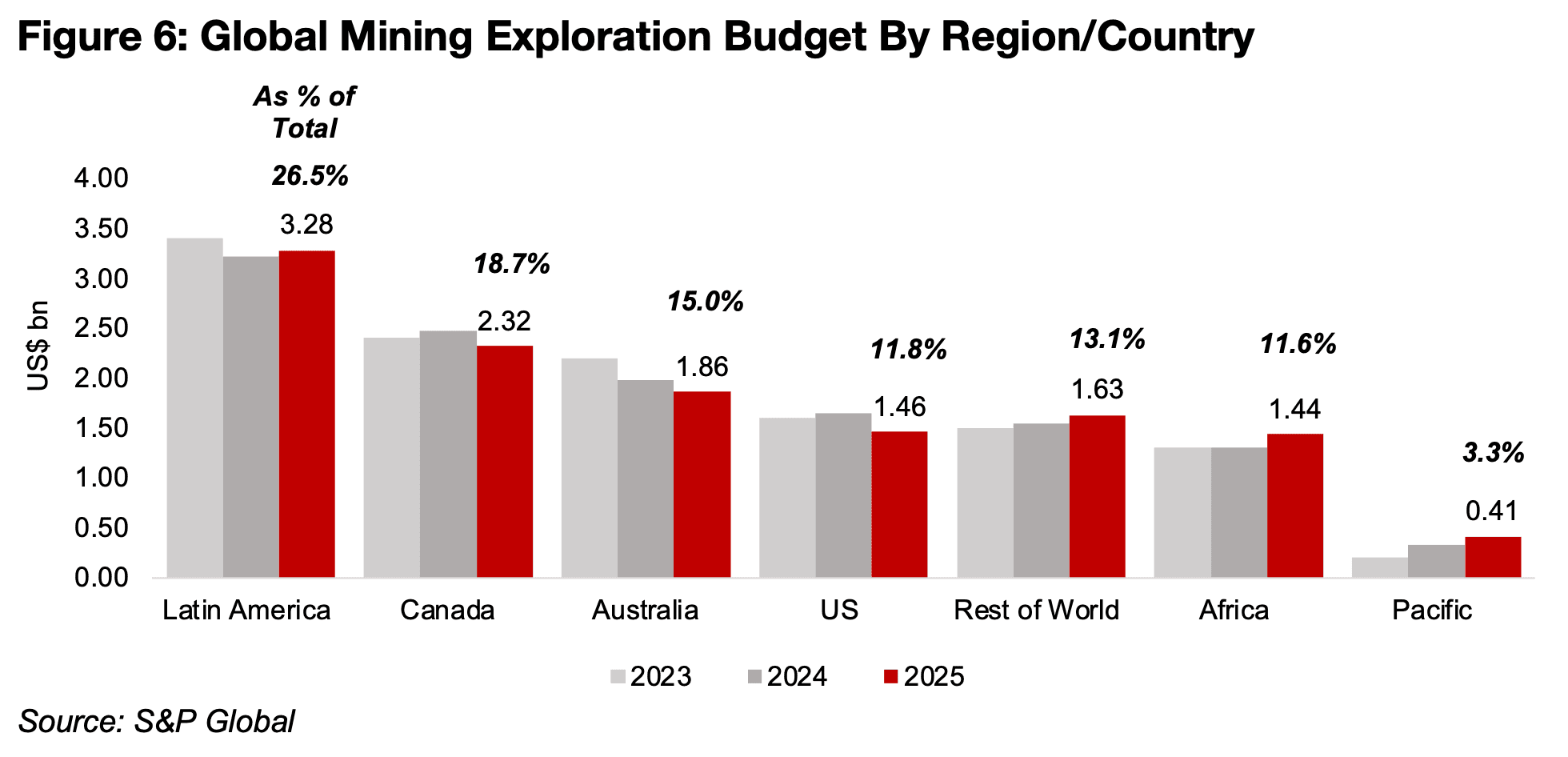
While the largest exploration regional budget in 2025 was in Latin America, at US$3.28bn, or 26.5% of the total, this comprises several countries, and on a national basis, Canada, Australia are the clear leaders, with US$2.32bn and US$1.86bn, or 18.7% and 15.0% of the total respectively (Figure 6). The U.S. is also a major player, at US$1.46bn, or 11.8% of the total, with Africa at US$1.44bn, or 11.6%.
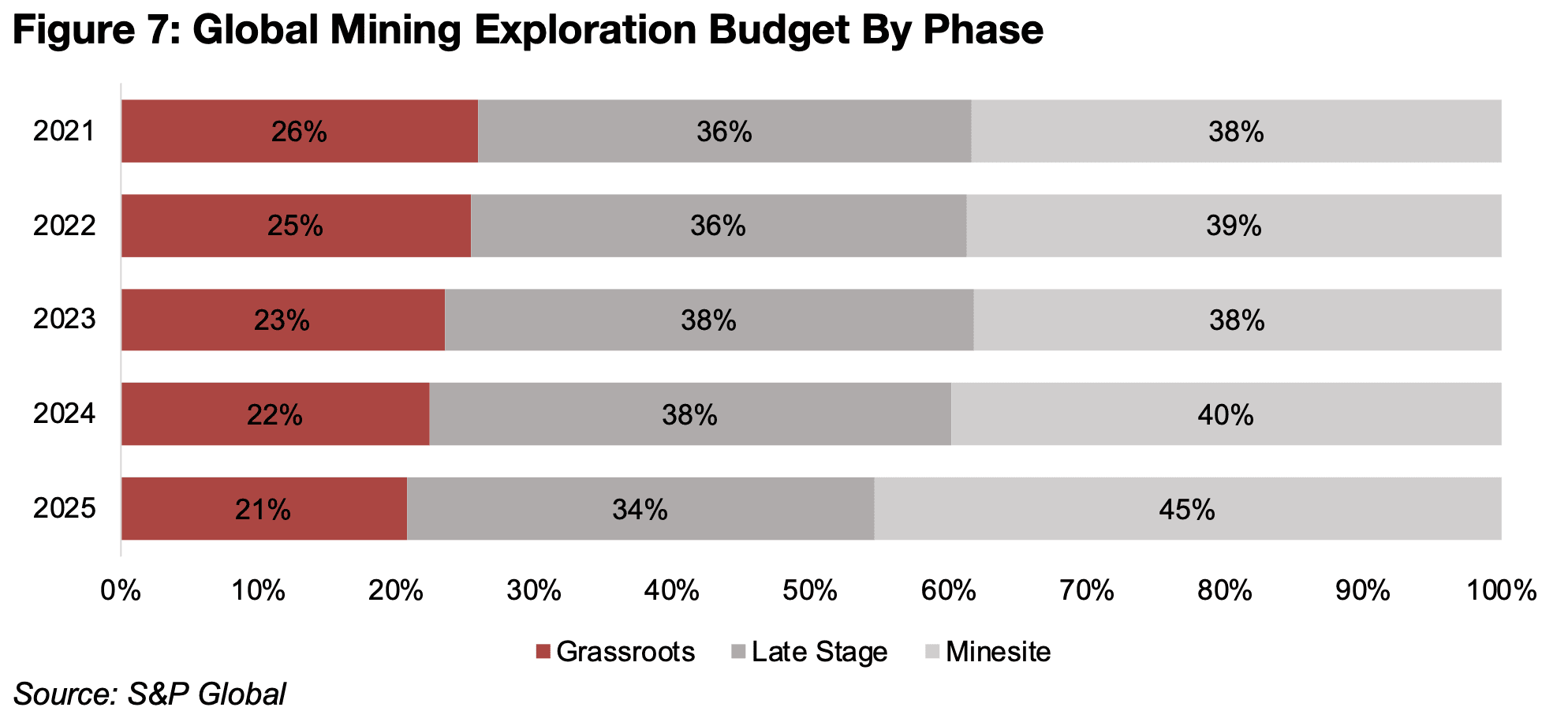
There has been a clear shift in the proportion of mining exploration budgets over the
past few years towards minesite development, rising from 38% of the total in 2023 to
45% in 2025. (Figure 7). The largest decline has been from late-stage exploration,
which dropped from 38% in 2023 to 34% in 2025, with grassroots down moderately
to 21% from 23% over the same periods.
S&P Global has also reported an indicator of more recent exploration trends through
to Q1/26 through its Exploration Jurisdiction Power Score (EJPS). This is based on
the number of drill holes reported, with one point per hole, new Initial Resource
announcements, for 100 points each, and Feasibility, Permitting and Production
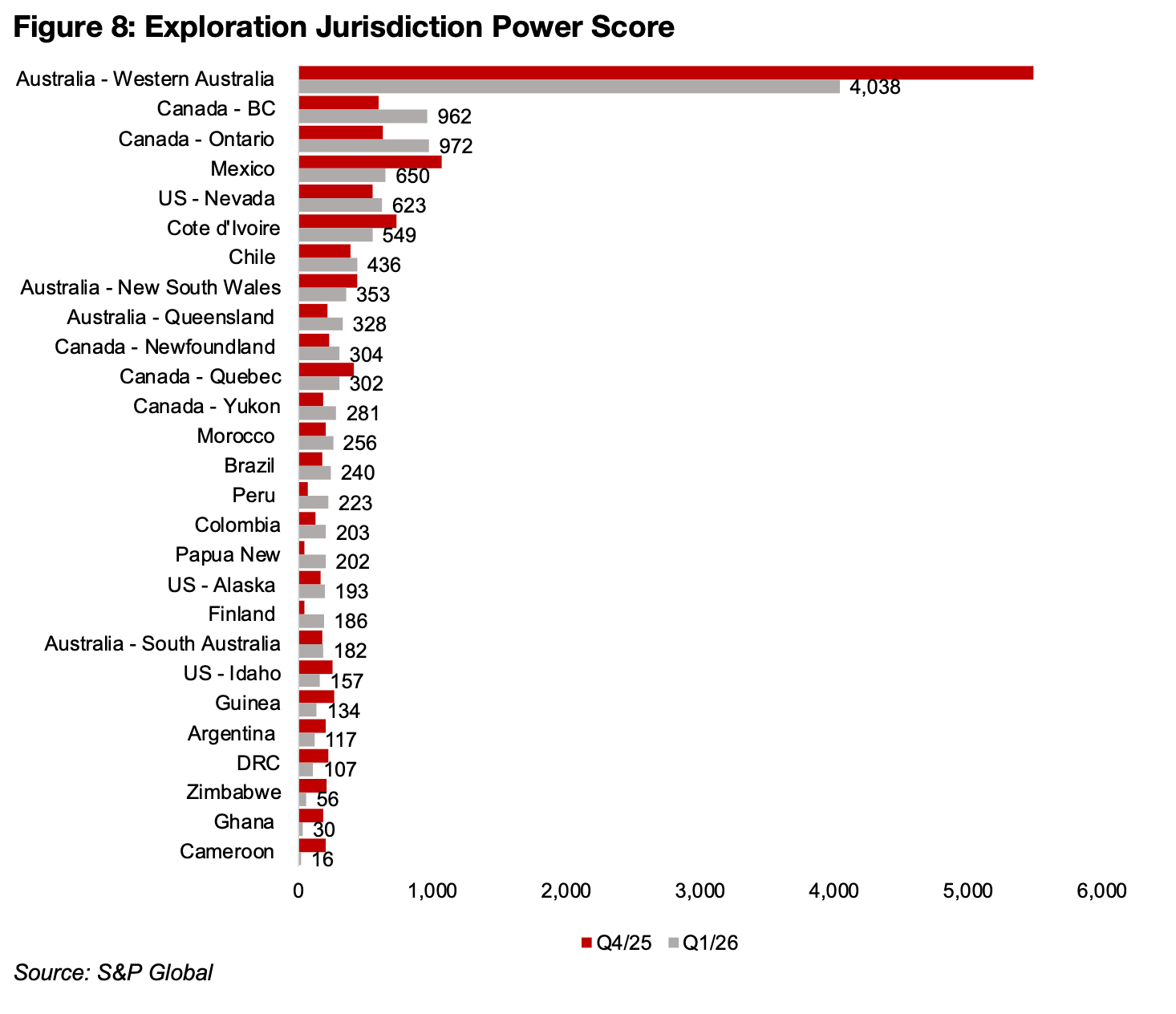
decisions also at 100 points. In Q1/26 Western Australia was by far global leader for
the EJPS, with 4,038 points, even with a nearly a 1,500 point decline from Q4/25, with
3,738 points from drillholes, 200 from key operating progress decisions and 100 from
new Initial Resources (Figure 8).
This Australian province is an extreme outlier, with an EJPS at around four times the
next two highest scores, which are both in Canada, with British Columbia and Ontario
at 962 and 972, respectively. The EJPS drops significant again for Mexico, Nevada
in the US and Cote D’Ivoire, with scores of 650, 623 and 540, respectively, and the
rest of the top ten are below 500, with Chile, and Australia’s New South Wales and
Queensland, at 436, 353, and 328.
There has been an increase in EJPS for about half the regions and decline for the rest
in Q1/26 versus Q4/25, with reasonably high weighting in terms of drill holes for both,
not indicating a major expansion or contraction overall in exploration activity globally
in early 2026. However, this has been overshadowed by the huge weighting of
Western Australia, especially in terms of drillholes, which offset much of the gains for
the rest of the world.
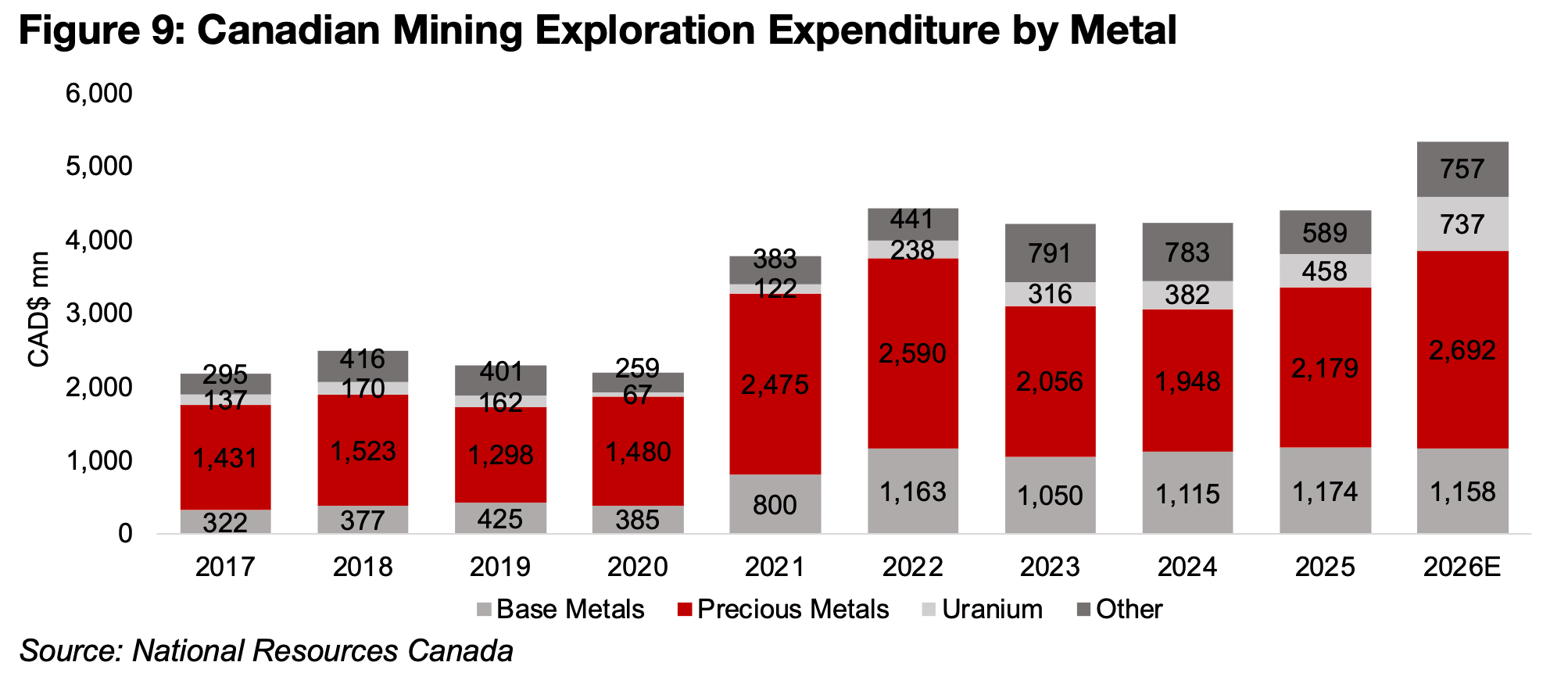
While S&P Global exploration budgets are available to 2025 and the EJPS to Q1/26,
there are projections for Canadian exploration expenditure for 2026E from Natural
Resources Canada. The gold sector in Canada has seen by far the largest investment
over the past decade, and this is expected to rise to CAD$2.69bn for 2026E from
CAD$2.18bn in 2026E, with base metals second, edging down to CAD$1.15bn from
CAD$1.17bn (Figure 9). Major increases are also expected for uranium, US$0.73bn
in 2026E from US$0.49bn in 2025, and other metals, to US$0.76bn from US$0.59bn.
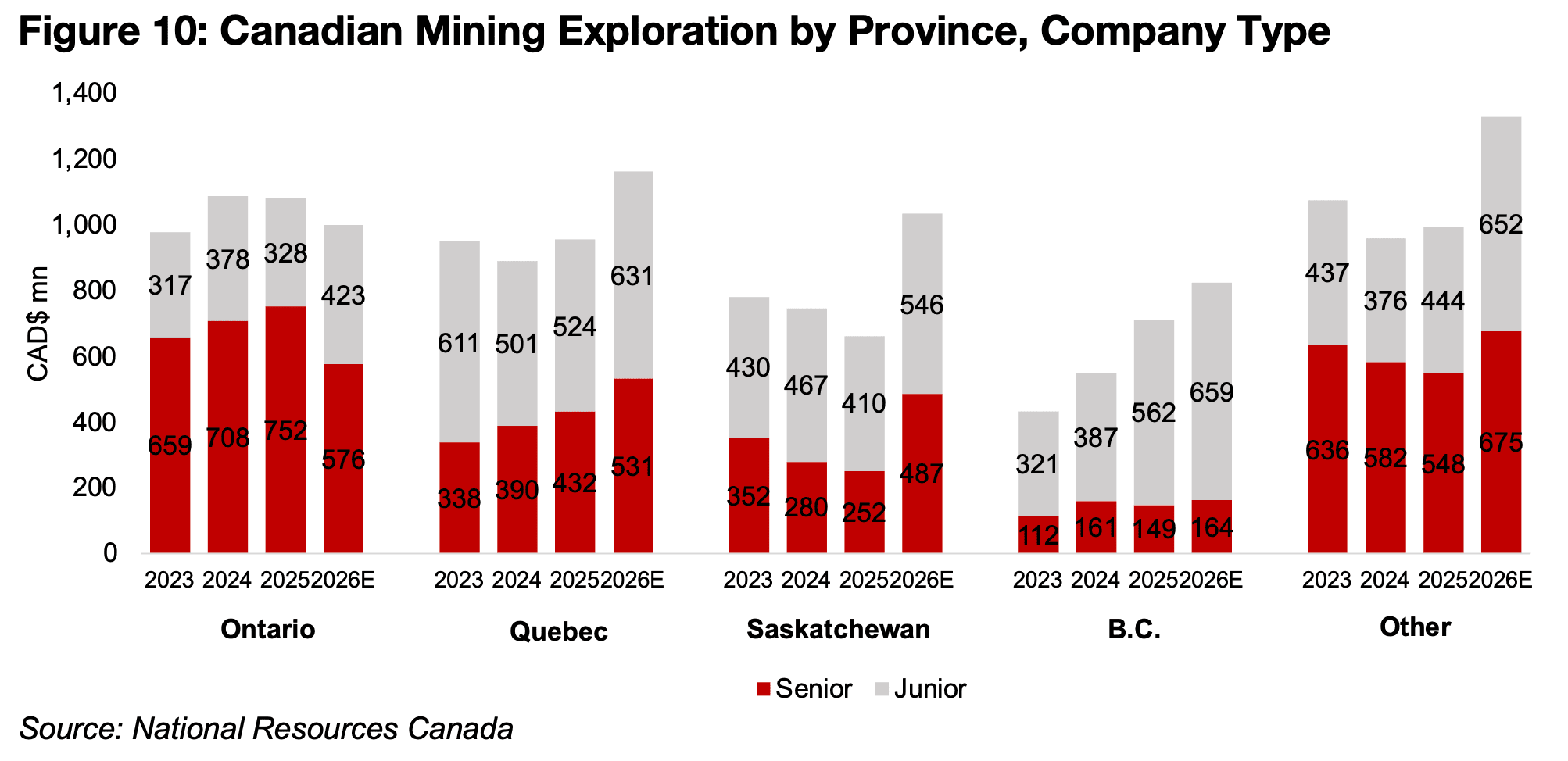
While Ontario was the leader for exploration investment from 2023 to 2025, major
changes are expected in 2026E, with Quebec jumping to first and Saskatchewan
rising second (Figure 10). The investment in Ontario is more driven by senior miners,
while Quebec, Saskatchewan, and especially B.C. have a much higher proportion of
expenditure from the juniors.
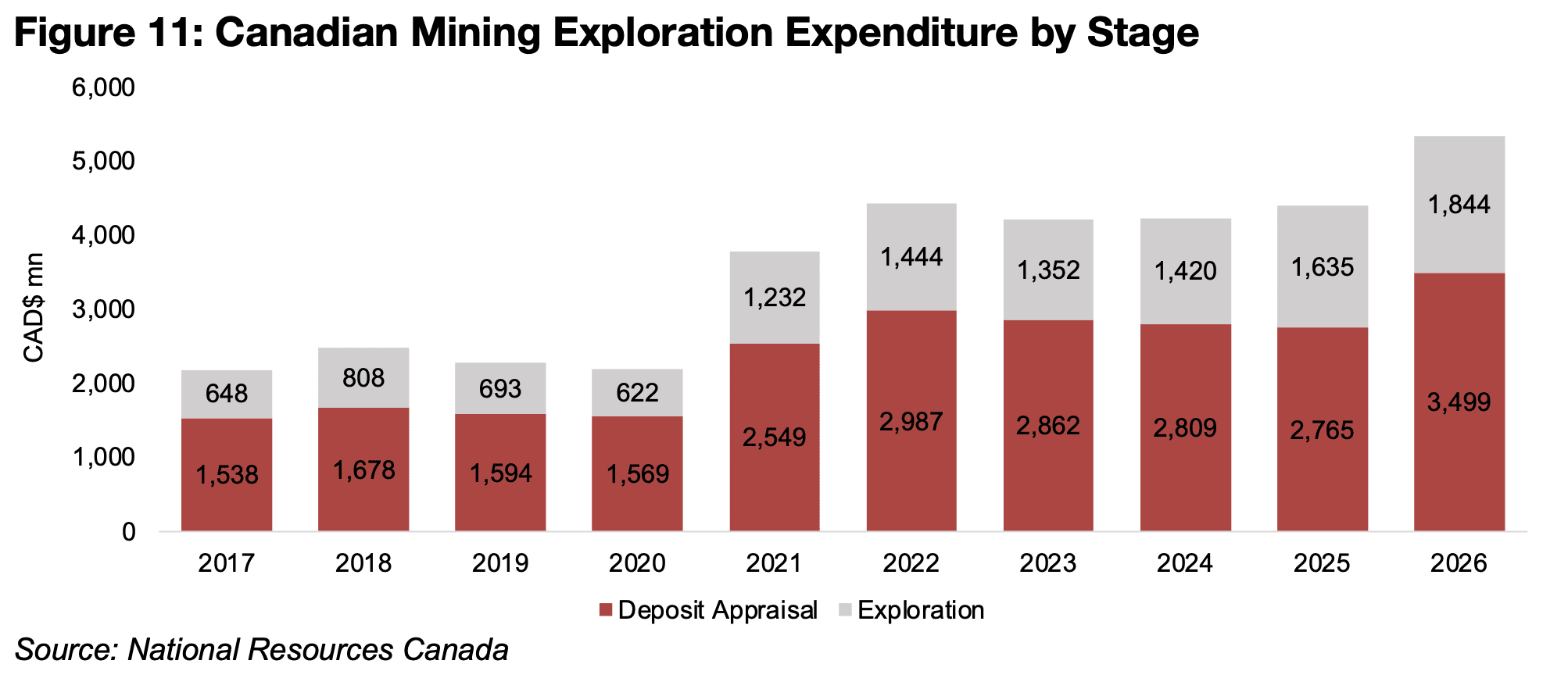
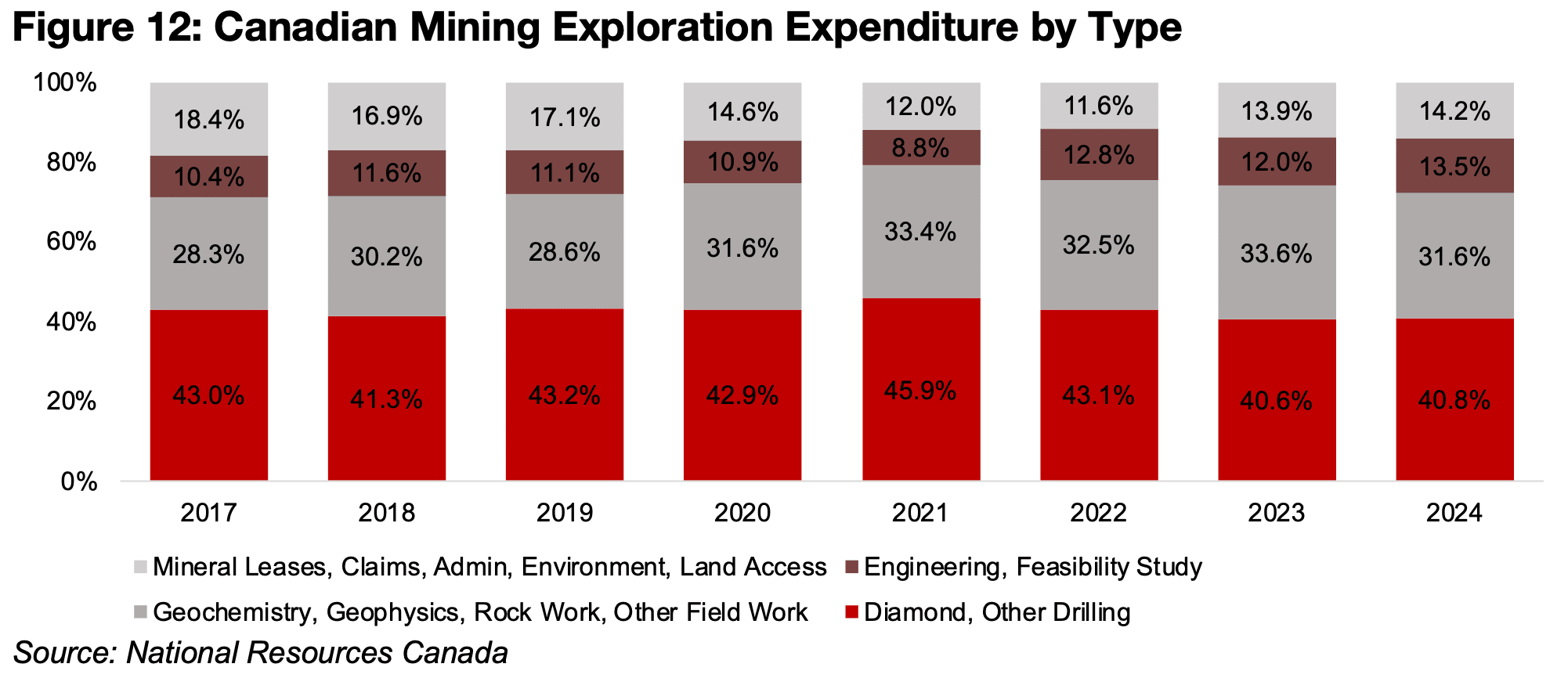
There is expected to a significant rise in the Canadian mining exploration investment for the deposit appraisal stage, which includes PEAs and Feasibility Studies, to CAD$3.5bn in 2026E from a range of CAD$2.8-CAD$3.0bn from 2022 and 2025, with earlier stage exploration investment rising to CAD$1.8bn from CAD$1.6bn, driven especially by rising metals prices increasing in the economic viability of the projects (Figure 11). Investment in expenditure by type is available only through to 2024, with drilling declining from a peak for 45.9% in 2021 to 40.6% in 2022 and 40.8% for 2024 (Figure 12). There has also been an increase in the share of investment in engineering and feasibility studies from a low of 8.8% in 2021 to 13.5% in 2024.
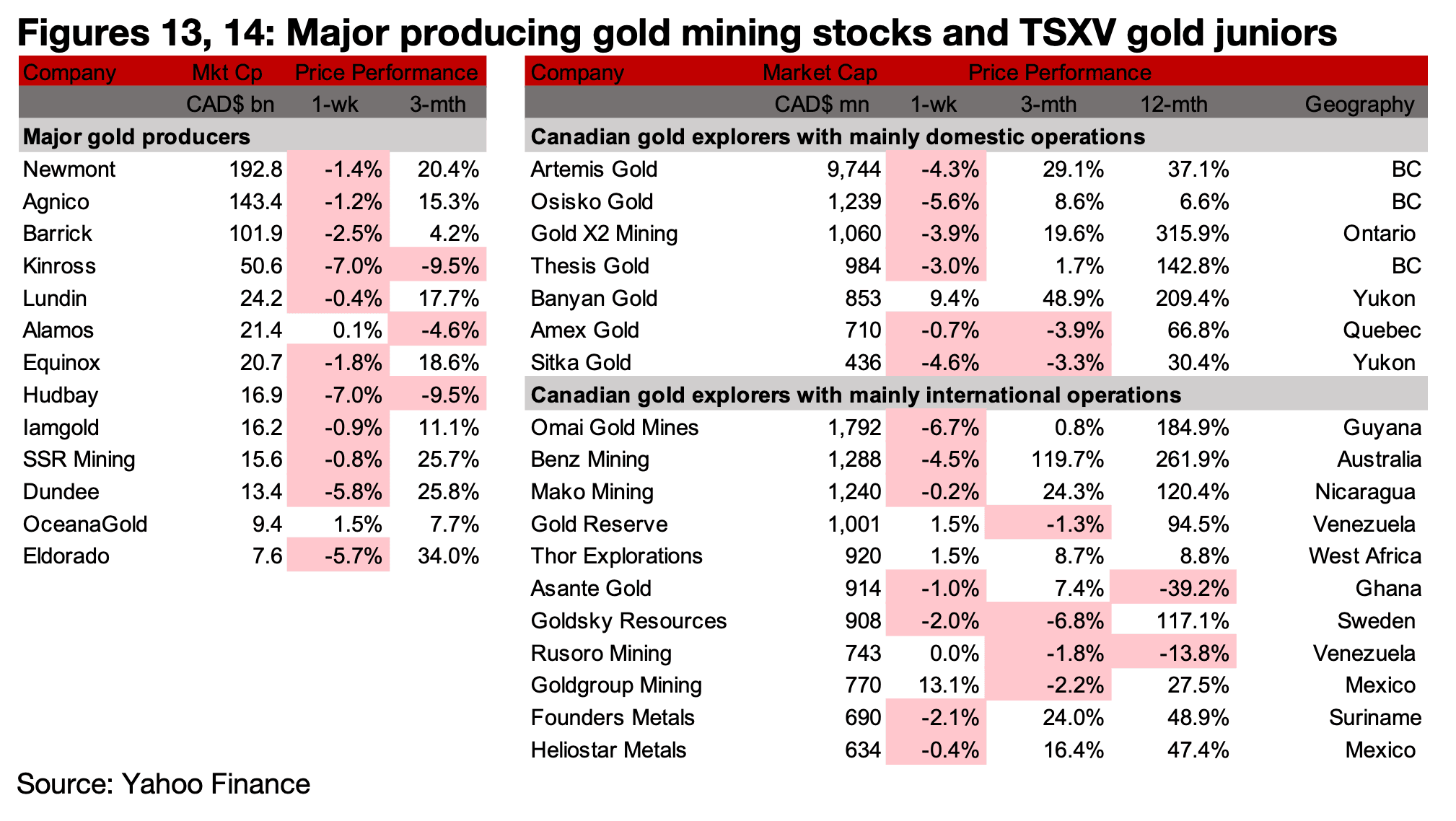
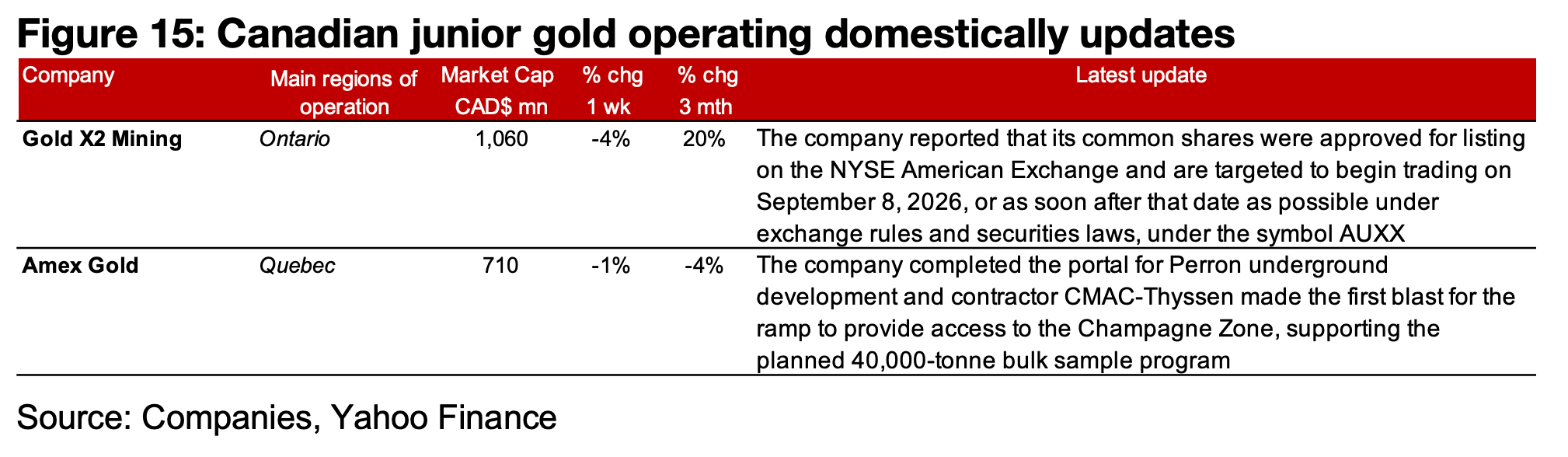
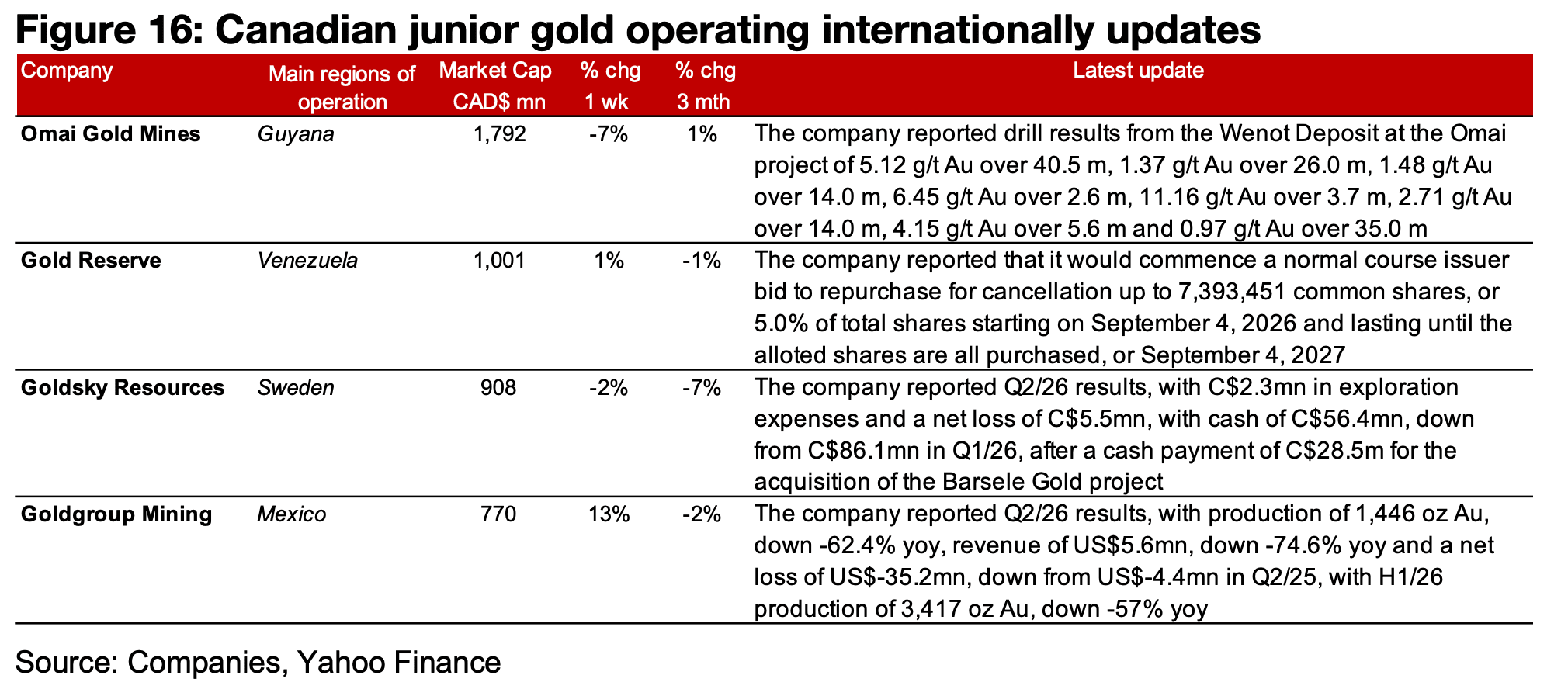
The major producers and TSXV gold mainly declined (Figures 13, 14). For the TSXV gold companies operating mainly domestically Gold X2 announced that its shares had been approved for listing on the NYSE American Exchange with trading targeted to start by September 8, 2026 and Amex Gold completed the portal for Perron and made the first blast for the ramp to provide underground access to the Champagne zone of the project, supporting the planned 40,000-tonne bulk sample program (Figure 15). For the companies operating mainly internationally, Omai reported drill results from the Wenot Deposit, Gold Reserve commenced a normal course issuer bid to repurchase up to 7.4 mn shares, and Q2/26 results were reported by Goldsky, with its cash declining to C$56.4mn after a C$28.5mn payment to acquire Barsele, and by Goldgroup, with production of 1,446k oz Au, down -62.4% yoy, revenue of US$5.6mn, declining -74.6% and a net loss of US$-35.2mn (Figure 16).
Disclaimer: This report is for informational use only and should not be used an alternative to the financial and legal advice of a qualified professional in business planning and investment. We do not represent that forecasts in this report will lead to a specific outcome or result, and are not liable in the event of any business action taken in whole or in part as a result of the contents of this report.
Author
Ben McGregor authors the Weekly Roundup at CanadianMiningReport.com, providing sharp analysis of the metals and mining sector. With a talent for spotting trends, Ben distills complex market shifts into clear, engaging insights on TSXV junior miners. His weekly updates cover gold, copper, uranium, and more, blending data-driven perspectives with a knack for identifying opportunities. A vital resource for investors, Ben’s work navigates the dynamic junior mining landscape with precision.