

October 19, 2026
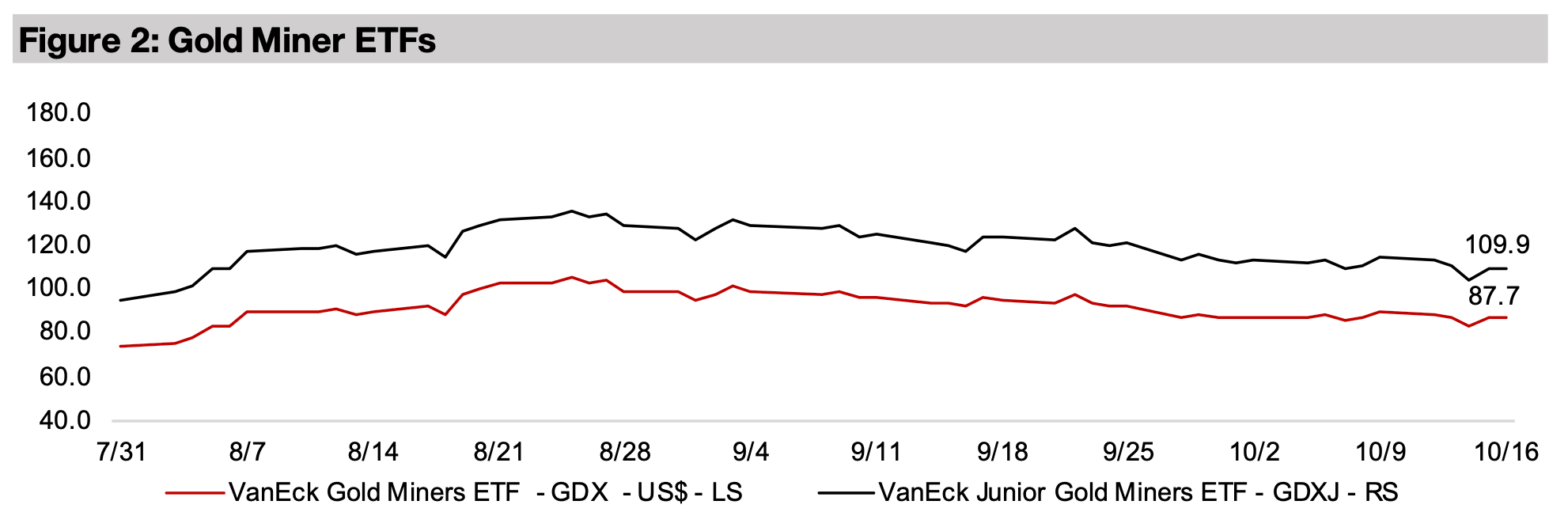
The gold stocks declined, with the GDX down -1.8 and the GDXJ losing 4.0% on the drop in the metal price and overall pullback in equities, with the S&P 500 losing - 2.0%, the Nasdaq plunging -4.4% and the Russell 2000 off 3.0%.


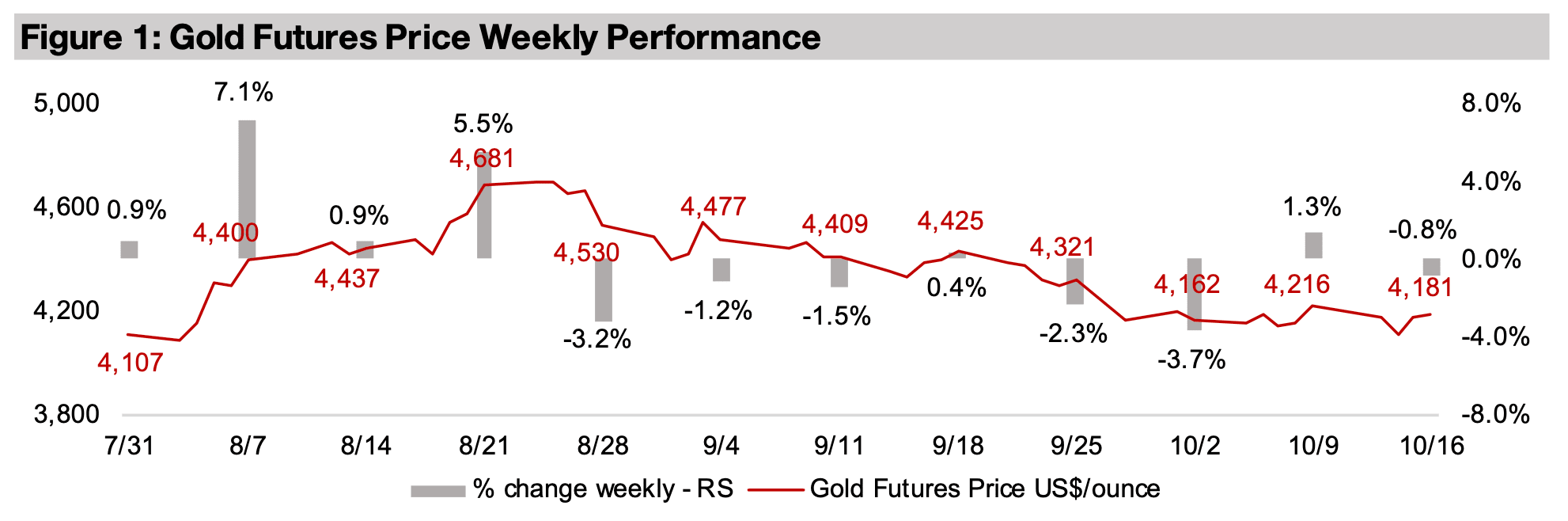
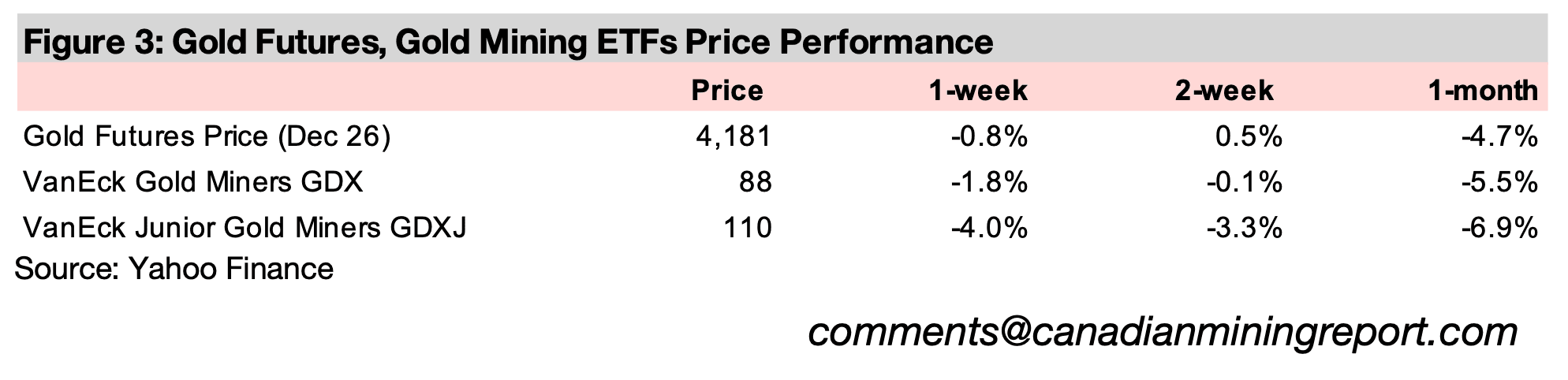
The gold price declined -0.8% to US$4,181/oz which appears to have been mainly
driven by a higher than expected rise in US CPI inflation. However, this was likely was
offset partly by a flight to safety on the crash in the AI sector, which led to a -4.4%
plunge in the Nasdaq, but also dragged down other major indices, with the S&P 500
losing -2.0% and the Russell 2000 index of small caps off -3.0%. The drop in the
golds stocks broadly reflected the outperformance of the large caps outside of tech
and underperformance of small caps, with the GDX ETF of major producers down -
1.8%, ahead of the smaller cap GDXJ ETF of junior miners, declining -4.0%.
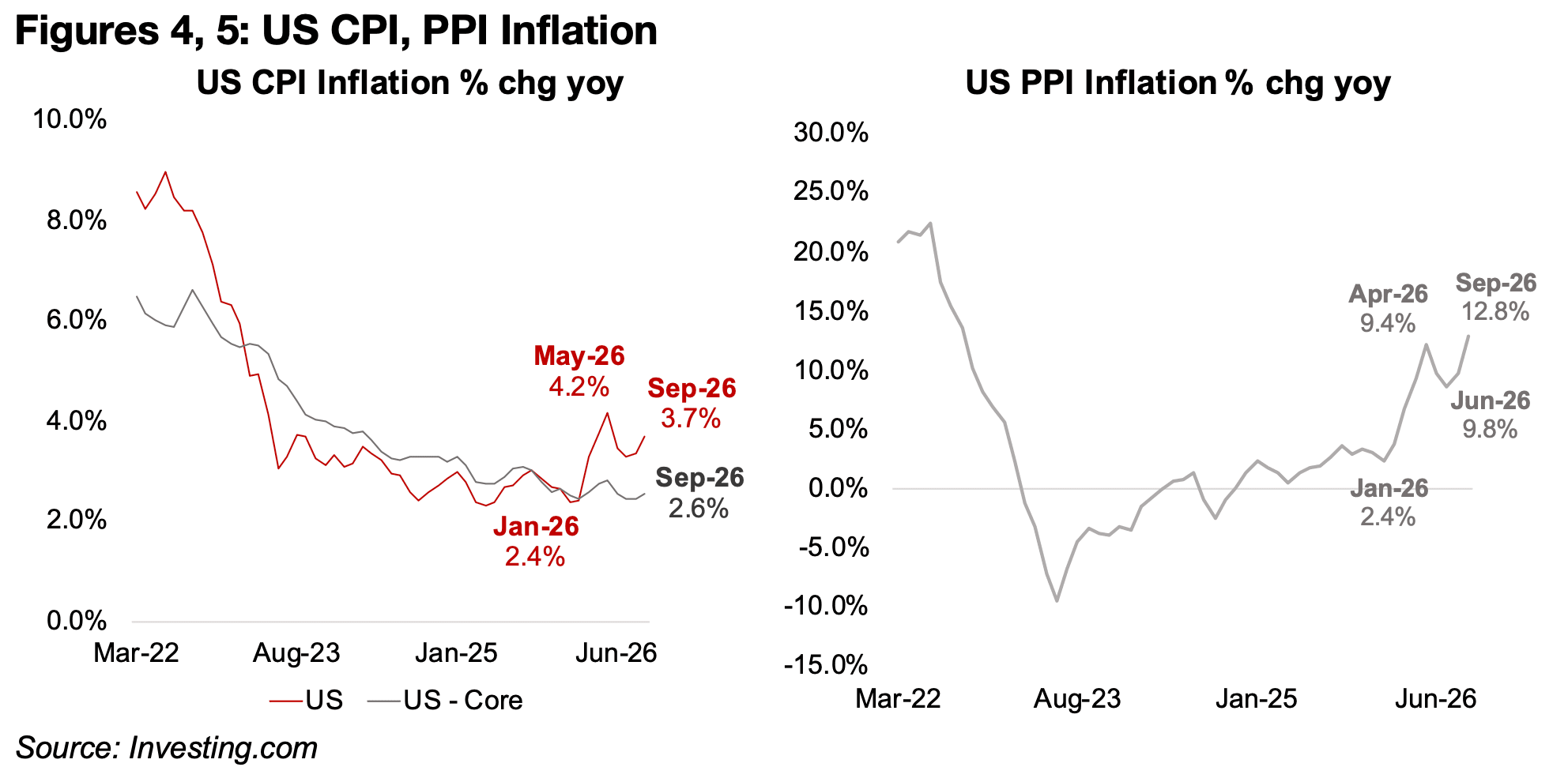
Inflation in the US for September 2026 rebounded especially on high energy costs,
with headline CPI at 3.7%, ahead of market expectations for 3.6%, and up from
recent lows of 3.3% in July 2026 (Figure 4) Core inflation, excluding volatile energy
and food prices, edged up to 2.6%, ahead of forecasts for 2.5%, and has remained
relatively flat this year in a range of 2.5%-2.8%. The US PPI saw a much larger jump,
to 12.8%, its highest level since 2022, over two times the 5.5% consensus forecast
(Figure 5). This implies that the CPI could rise further as these higher costs could
eventually move down the supply chain to consumer prices. This led to expectations
that the Fed could be under pressure to raise rates again at least once this year.
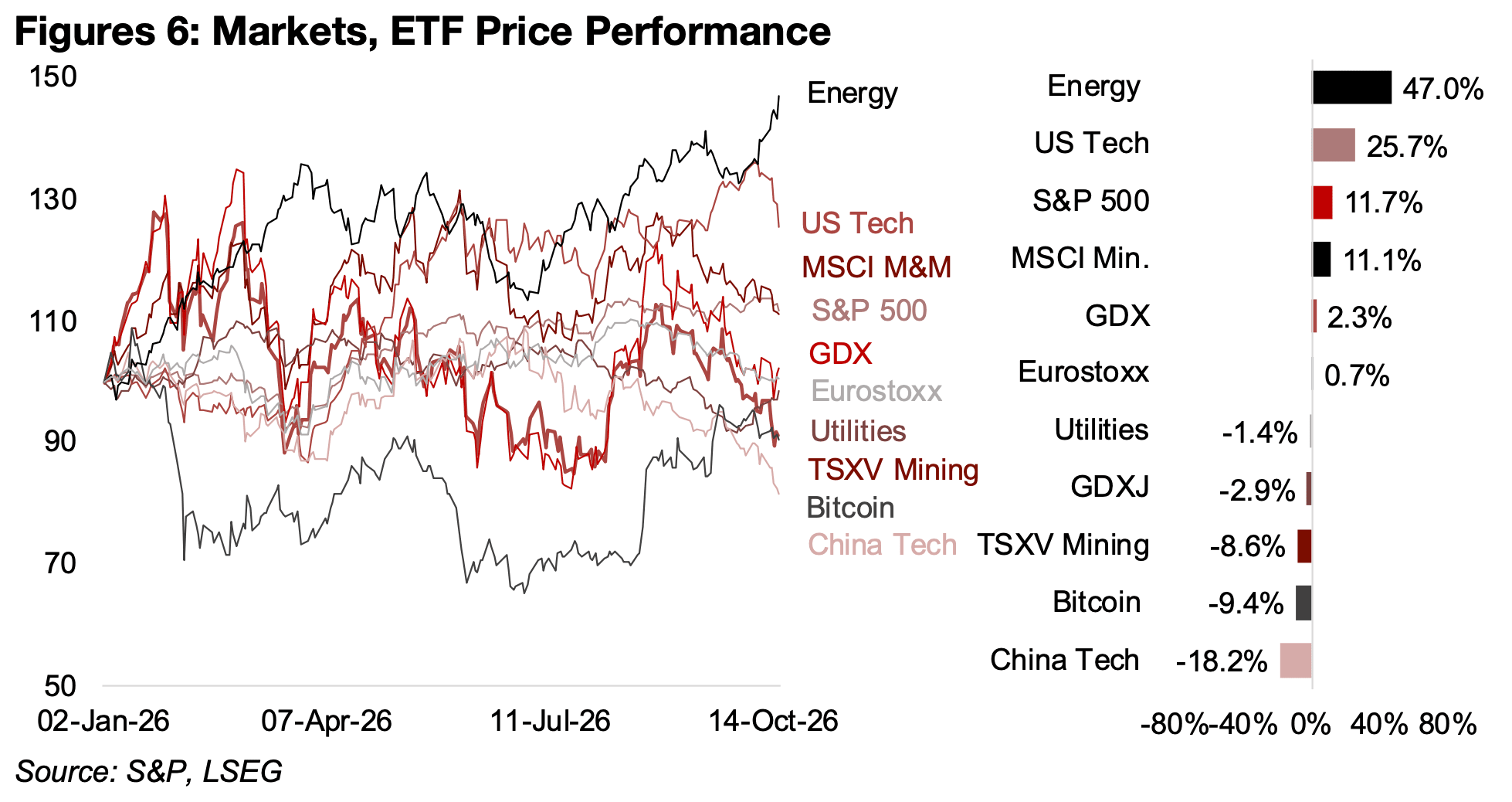
Even with the huge slump this week, the US tech sector is still up 25.7% on the
Dotcom 2.0 AI boom, only surpassed by energy, up 47.0%, driven by rising global
costs for oil and other fuels on the continued conflict in the Middle East (Figure 6). US
Tech has more than doubled the performance of the S&P 500, up 11.7%, and the
MSCI Mining and Metals ETF, up 11.1% mainly from its large weighting to companies
with high exposure to the rising copper price.
The GDX ETF has edged up just 2.3%, showing a market quite balanced in its outlook
for the sector, with the -2.9% decline in the GDXJ only moderately behind this.
Eurostoxx and utilities are also near flat, up 0.7% and down -1.4%, with the latter
another key defensive sector, similar to gold. TSXV Mining has underperformed,
down -8.6%, given that is mainly riskier microcap stocks, with a heavy weighting to
gold, and around the level of the -9.4% drop in Bitcoin. The weakest performance
has come from China Tech, which has declined since July 2026 and is off -18.2%.
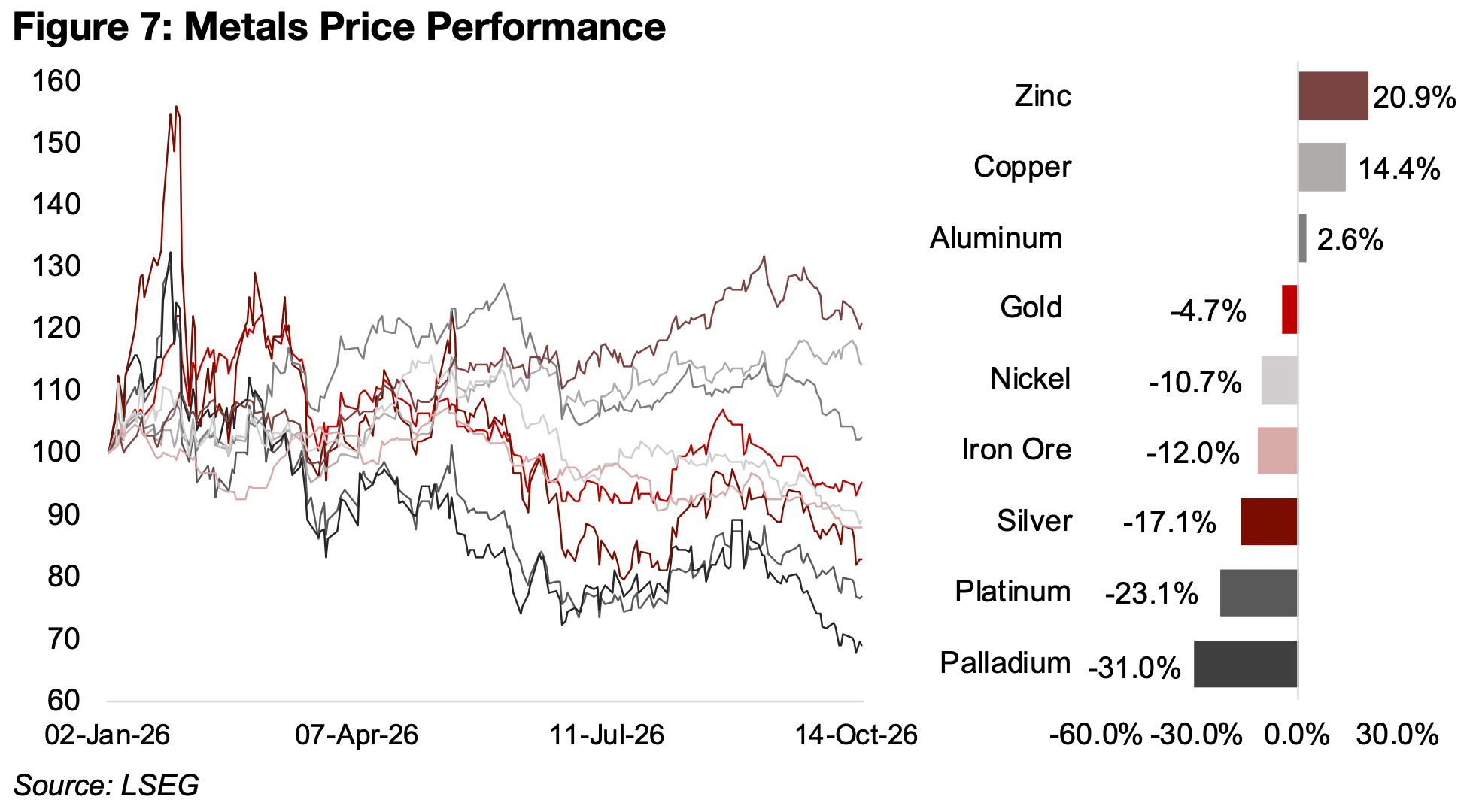
The major metals all declined over the past week and most are down substantially this year, with the exceptions of zinc and copper (Figure 7). The latter has been driven by huge distortions in global inventories towards the US and away from Europe and China on concerns over further potential tariffs on the metal but also high demand from the data center expansion supporting the AI boom. Aluminum is up just 2.6%, as it has much lower demand from AI than copper, but has been boosted supply cuts in the Middle East, a key global producer of the metal.
Two of the main metals driven mainly by steel demand, iron ore and nickel, are down this year as growth in sector has remained weak, with sluggish property and infrastructure sectors in China a key factor. Iron ore has also been hit by huge new supply from the new Simandou mine in Guinea, and while the global nickel oversupply has improved on capacity expansion limitations imposed by Indonesia, the world’s largest producer, it still remains high. While majority of zinc demand is also from steel sector, the metal has increased this year on a severe supply shortage. The precious metals have struggled, with silver, platinum and palladium all facing considerable contractions this year, and gold the clear outperformer, down only around -5.0%.
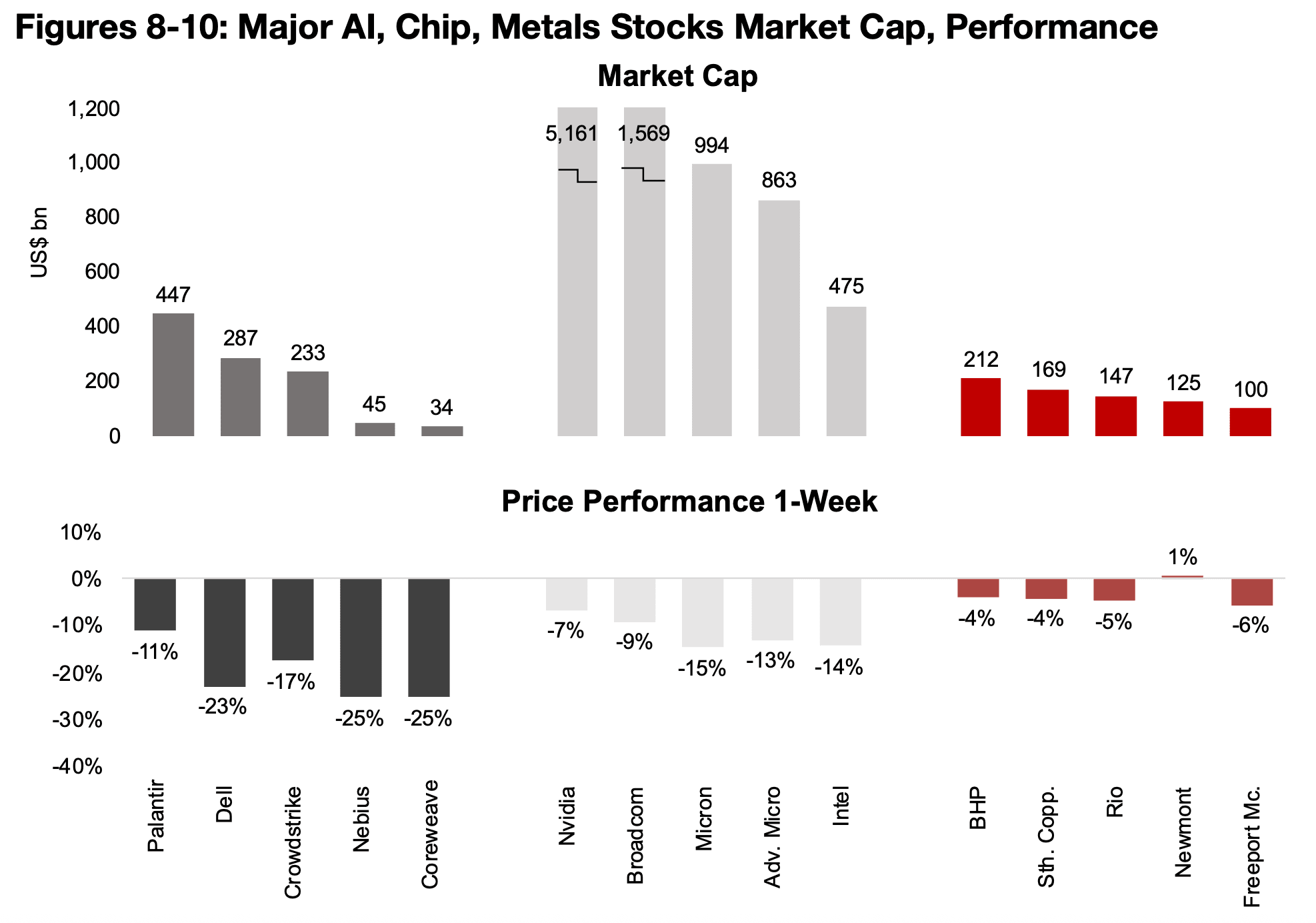
The AI crash this week especially hit several of the companies with more moderate
market caps in the sector, including Palantir, Dell, Crowdstrike, Nebuis and
Coreweave, which plunged -11%, -23%, -17%, -25% and -25%, respectively
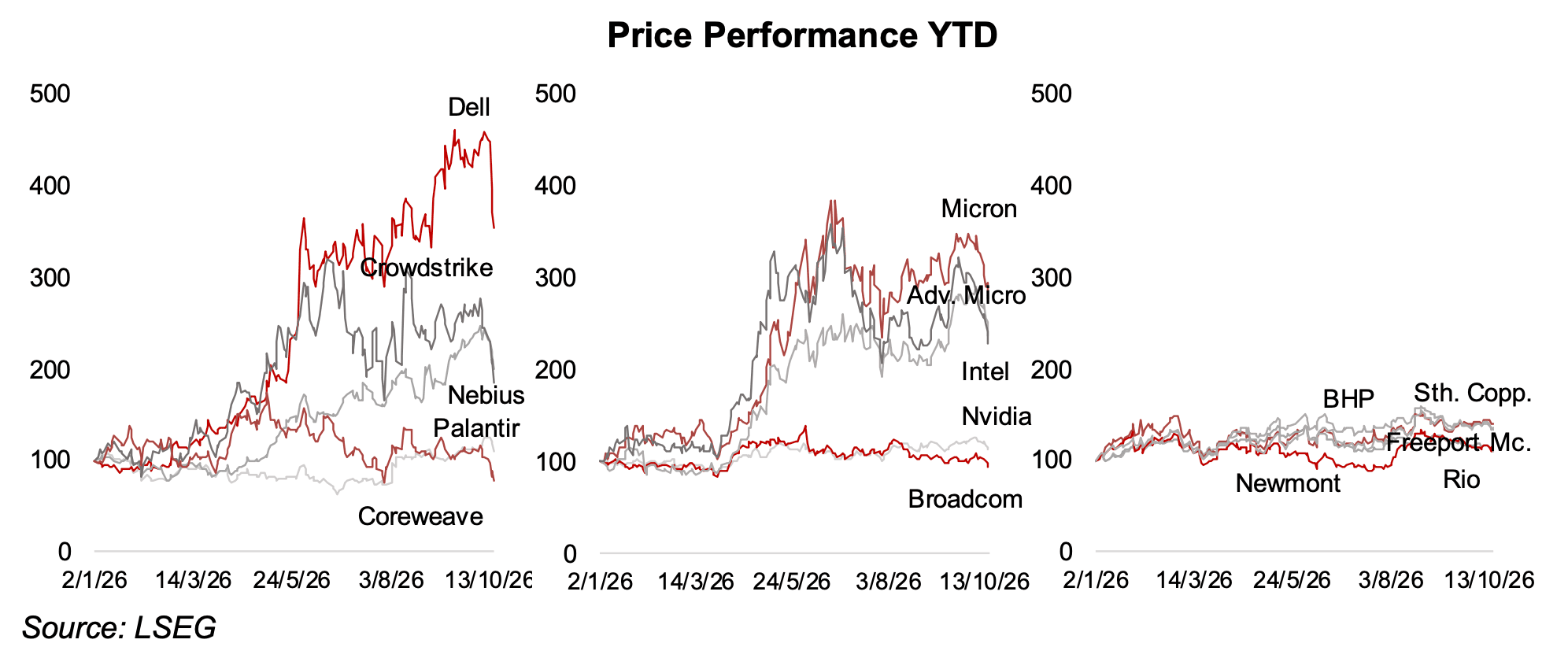
(Figures 8, 9). However, for Dell, Crowdstrike and Nebius this followed huge gains
earlier in the year, and left all three still up for the year, while Palantir has had much
more moderate gains for the years, and the slump only saw Coreweave decline into
substantial losses for the year (Figure 10).
The megacap chip stocks also dropped, but by much less, with Nvidia, Broadcom,
Micron, Advanced Micro Devices and Intel, down -7%, -9%, -15%, -13% and -14%.
However, these stocks had started to decline earlier than most of the smaller market
cap AI stocks, and overall have recently also seen similarly large drops, just not in a
single week. The market has become concerned over the ability of AI companies to
continue to raise financing, with the debt levels for many starting to become
excessive, especially with rising interest rates driving up funding costs.
The situation looked far more subdued for the largest market cap mining stocks this
week, which are similar in size to the mid-tier AI stocks, although still far smaller than
the mega chip stocks. The declines for BHP, Southern Copper, Rio and Freeport
McMoran were just -4%, -4%, -5% and -6% and Newmont actually saw a slight 1.0%
gain for the week, even with a weaker gold price. The performance of the group this
year certainly been far more muted than the AI boom, but this has also likely left the
sector less prone to extreme levels of leveraged speculation which can reverse
spectacularly, as was seen with the tech sector this week.
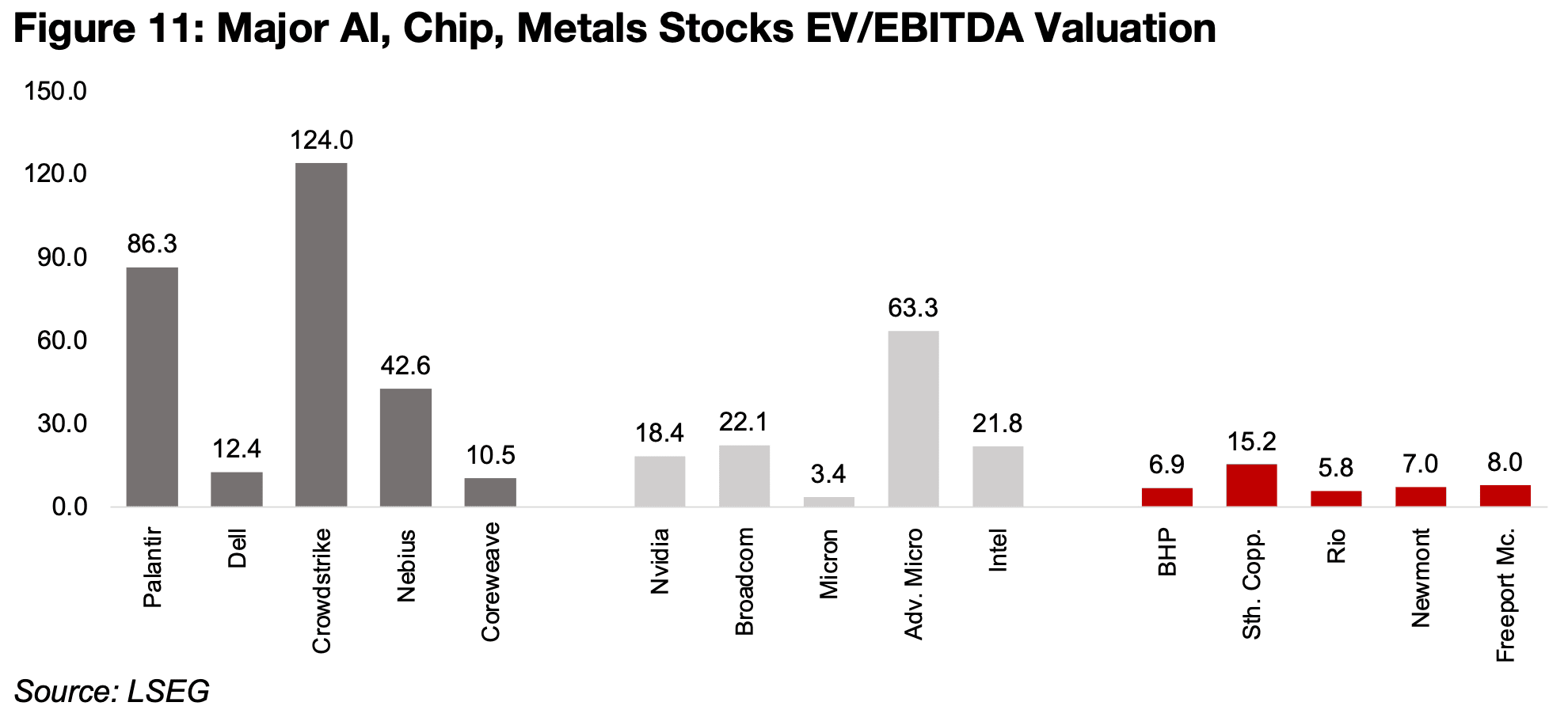
The mining sector also has support from considerably lower valuations based on
EV/EBITDA, which is a cash based multiple, with the total value of the firm’s equity
and net debt divided by the earnings before interest, taxes and depreciation and
amortization, or roughly the firm’s operating cash. The mining stocks range from just
5.8x to 15.2x, while many of the AI and chip stocks trade over 20.0x, reaching as high
as 80x-120x (Figure 11).
Of the metals, copper likely has the highest risk from an AI crash, with its gain this
year driven partly by demand from data center construction to power the sector’s,
with aluminum having much lower exposure to the sector. The precious metals,
especially gold and silver could be boosted by a downturn in AI on a flight to safety.
The outlook is less clear for platinum and palladium, with both driven by autocatalyst
demand, with limited exposure to AI, as a crash in the sector could lead to broader
economic issues and eventually reduce consumer purchases, especially for bigger
ticket items like vehicles. With iron ore, nickel and zinc mainly driven by global steel
demand, they would likely see a very limited effect from an AI crash.
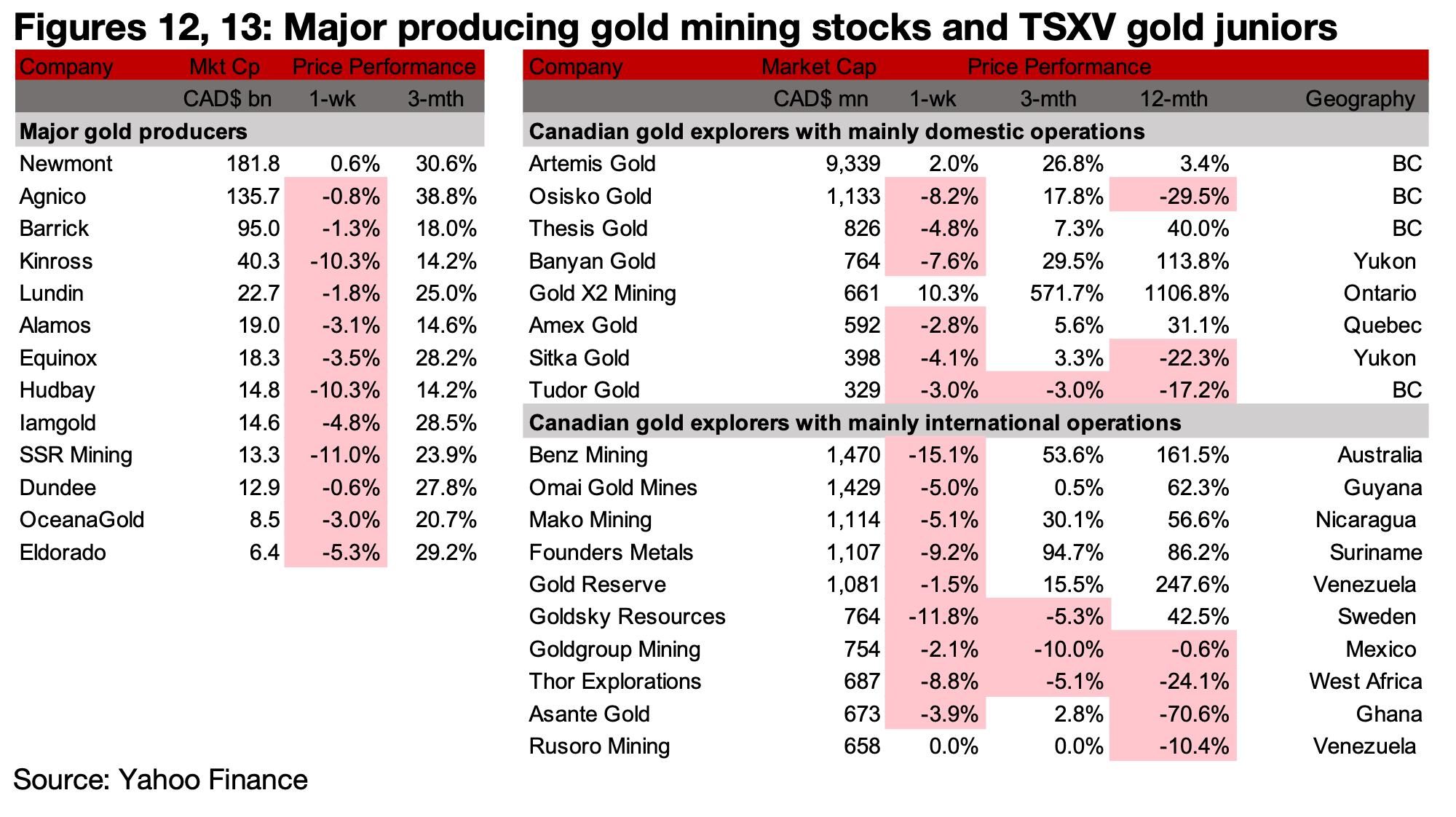
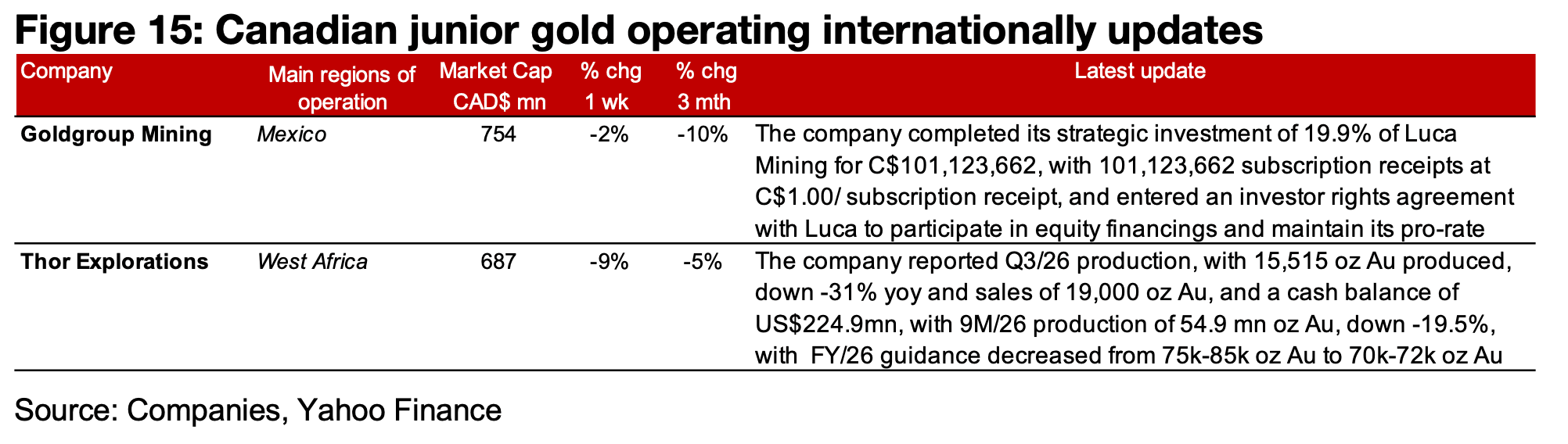
All of the major producers except Newmont and most of TSXV gold declined (Figures 12, 13). For the TSXV gold companies operating mainly domestically, Artemis Gold reported Q3/26 production, Gold X2 announced drill results from the Main and Southwest Zones of the Moss project, Sitka reported drill results from the Saddle and Eiger Zones of the RC project and Tudor reported drill results from the Perfectstorm Zone of Treaty Creek (Figure 14). For the companies operating mainly internationally, Goldgroup completed its strategic investment in Luca and Thor Explorations reported Q3/26 production results (Figure 15).
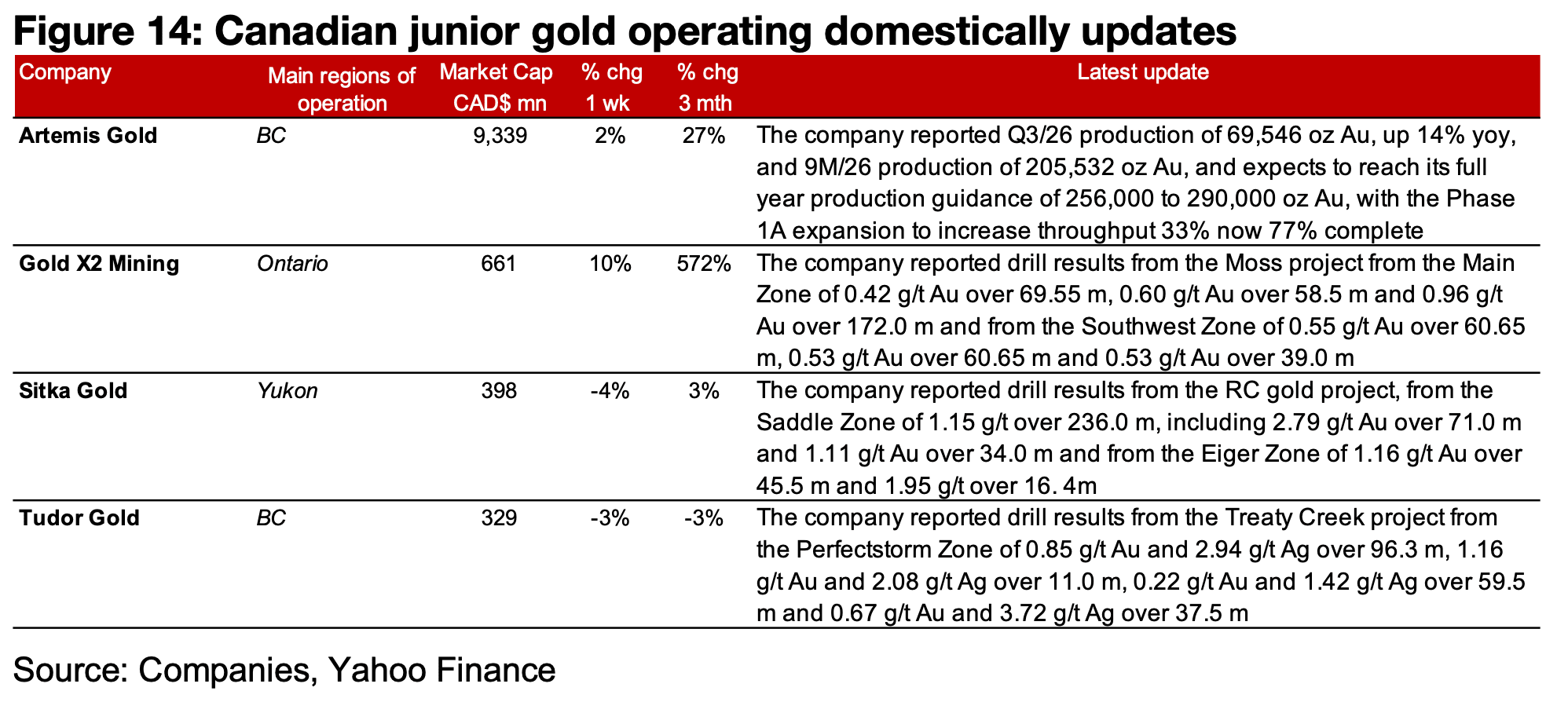
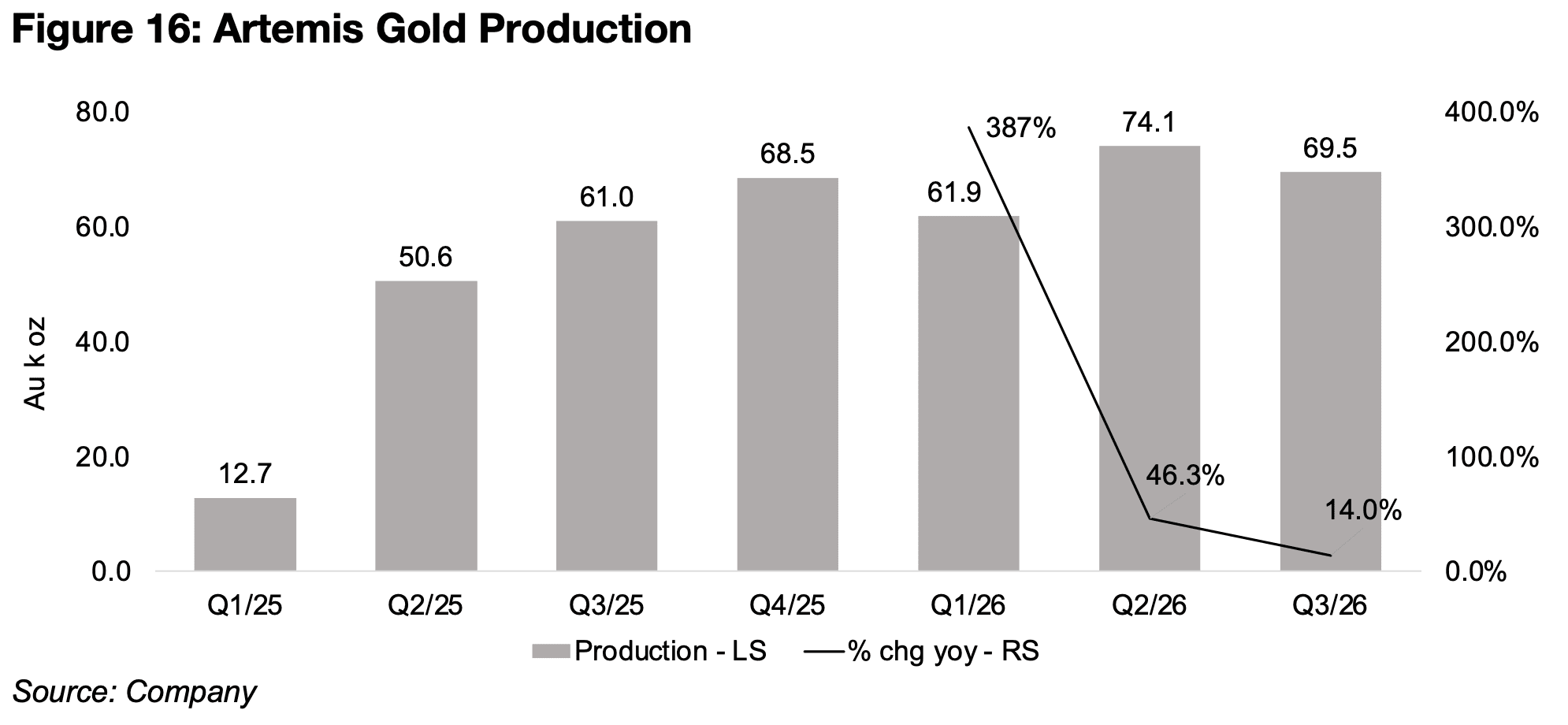
The production for Artemis Gold remained relatively strong at 69.5 k oz Au, up 14.0%
yoy, but was down -6.1% qoq from its Q2/26 peak at 74.1k oz Au (Figure 16). The
company only started ramping up production in Q1/25 at 12.7k oz Au, reached
commercial production in May 2025 and 50.6k oz Au of output in Q2/25, and had its
first full operating quarter in Q3/25, with 61.0k oz Au. The company has produced
205,532 oz Au this year and expects to reach its full year guidance for 2026 of 265,000
to 290,000 oz. The Phase 1A expansion which will increase the throughput by 33%
is now 77% complete and expected to be fully ready by Q4/26.
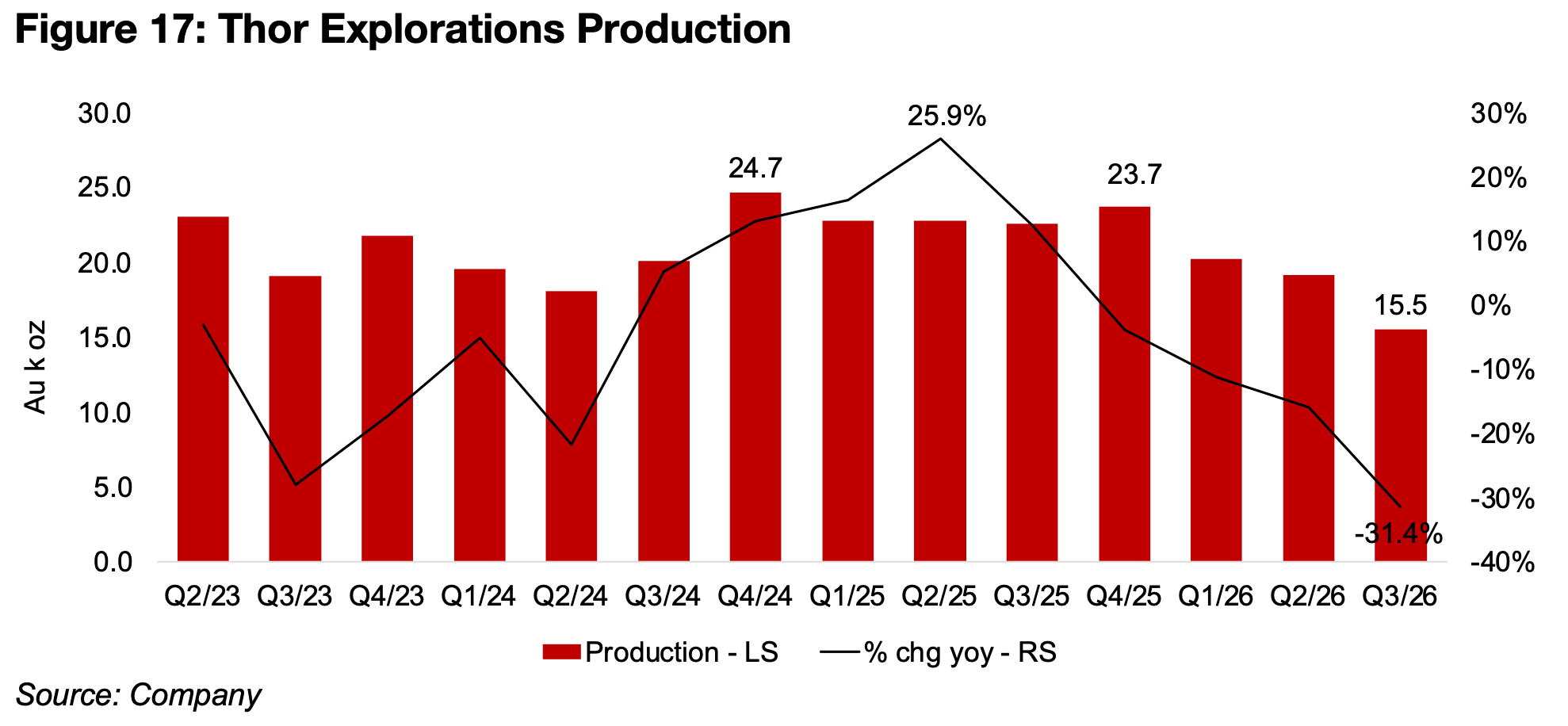
Thor Explorations production from Segilola reached a peak in Q4/24 at 24.7k oz Au,
the highest yoy growth rate in Q2/25 at 25.9% yoy, and then neared its previous highs
at 23.7k oz Au in Q4/25 (Figure 17). However, production has trended down since,
reaching 15.5k oz Au in Q3/26, declining -31.4% yoy, with weakness in the quarter
especially from extreme rainfall in late August. This has led the company to cut their
production guidance for this year from 75k-85k oz Au to 70k-72k oz Au. There has
also been a decline in the grade of the mine from 2.26 g/t Au in Q3/25 to a low of
1.54k g/t Au in Q2/26 before recovering to 1.69 g/t Au in Q3/26.
Disclaimer: This report is for informational use only and should not be used an alternative to the financial and legal advice of a qualified professional in business planning and investment. We do not represent that forecasts in this report will lead to a specific outcome or result, and are not liable in the event of any business action taken in whole or in part as a result of the contents of this report.
Author
Ben McGregor authors the Weekly Roundup at CanadianMiningReport.com, providing sharp analysis of the metals and mining sector. With a talent for spotting trends, Ben distills complex market shifts into clear, engaging insights on TSXV junior miners. His weekly updates cover gold, copper, uranium, and more, blending data-driven perspectives with a knack for identifying opportunities. A vital resource for investors, Ben’s work navigates the dynamic junior mining landscape with precision.