

November 02, 2026
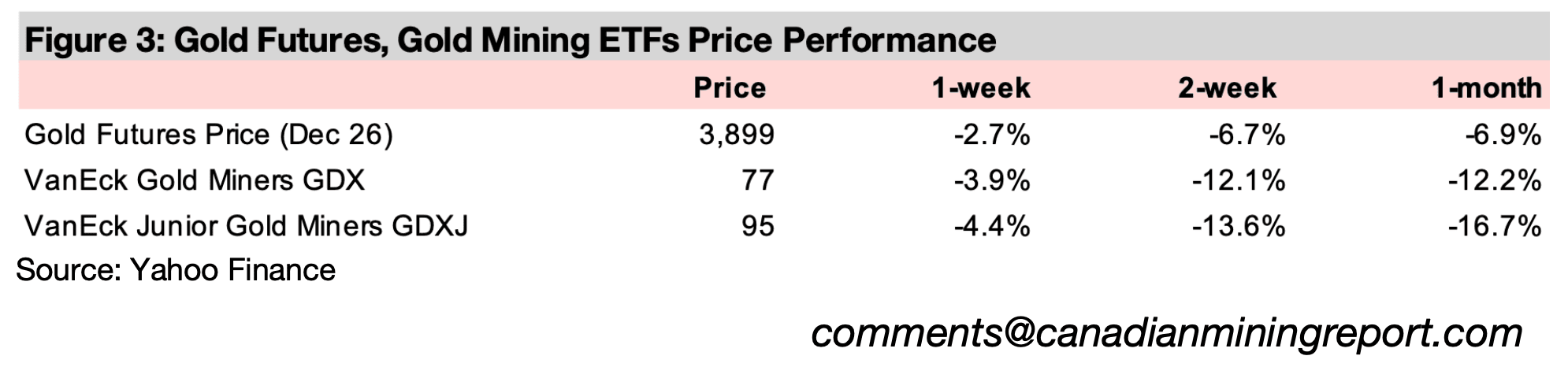
The gold price dropped -2.7% to US$3,899/oz, even as the Fed remained on hold, as the tech crash has likely driven forced liquidations of stronger performing assets to cover losses, including the gold sector with its huge gains over the past two years.
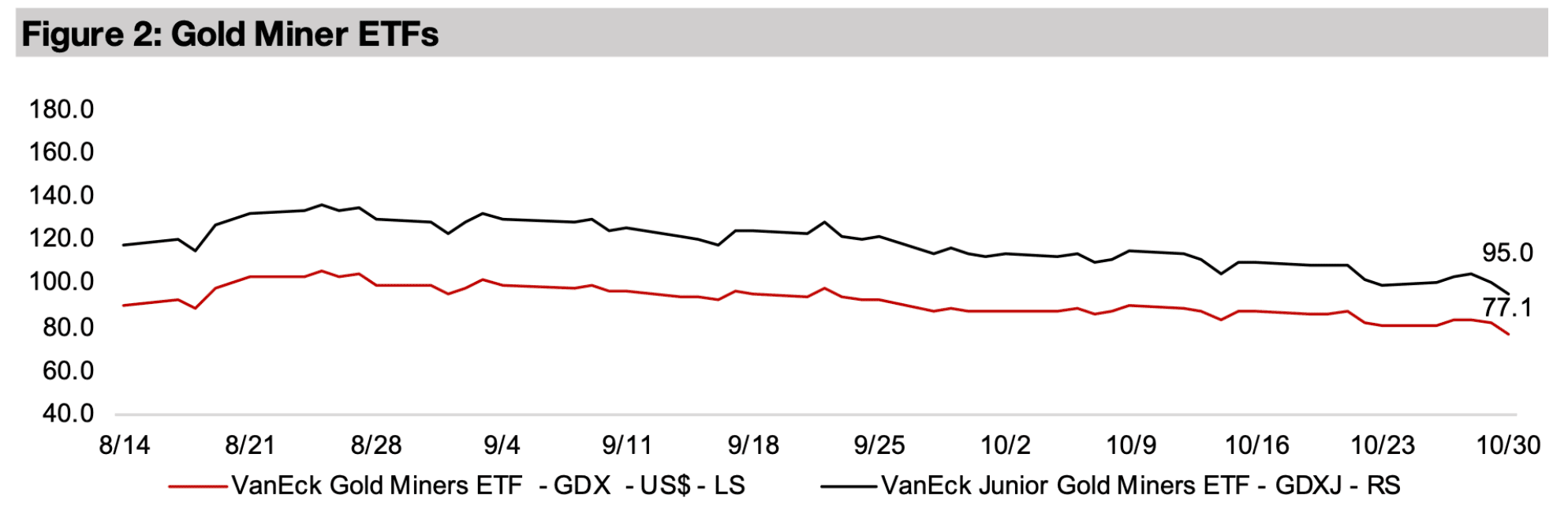
The gold stocks dropped with the GDX down -3.9% and the GDXJ losing -4.4% as the tech slump continued, dragging down the Nasdaq -2.3%, although the S&P 500 declined just 0.8% and Russell 2000 actually rose 1.1% on a shift into other sectors.


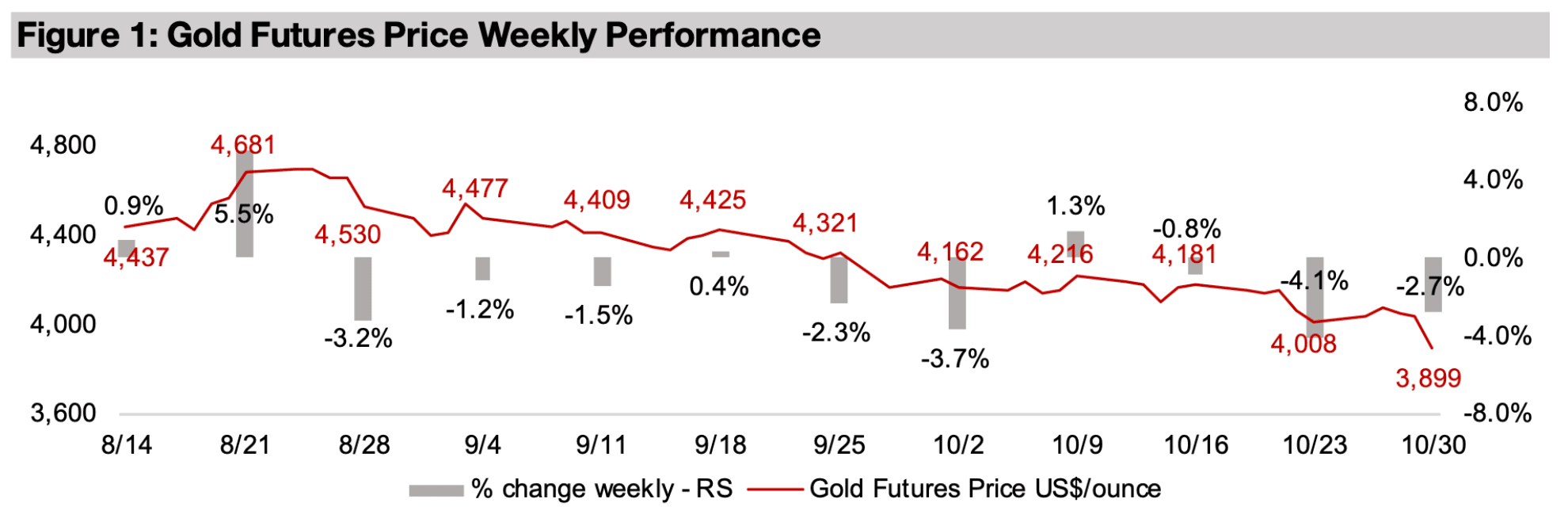
The gold price declined -2.7% to US$3,899/oz, down for a second week and breaking
below the key US$4,000/oz benchmark for the first time since July 2026. The metal
price and markets overall had edged up through to the US Fed rate decision in the
middle of the week, which provided some relief as the central bank remained on hold.
However, the markets slumped at the end of the week as the third quarter results of
several major tech companies, strongly disappointed the markets, especially Intel,
but also Alphabet (Google) and Amazon, which plunged -25.1%, -12.6% and -3.8%.
While this dragged down the Nasdaq -2.3%, the S&P 500 dropped only -0.8%, and
Russell 2000 index declined just -1.7%, indicating that the slump was mainly
concentrated in the tech sector.
While the shift into defensives continued, with global consumer staples, healthcare
and utilities up 1.1%, 2.9% and 1.6%, the gold sector was bypassed by the trend, as
it has been for the past month. This has likely been because the tech crash has driven
some funds into forced liquidations of holdings with strong gains to offset the losses
in the sector. The funds that have had positions in the gold sector for just the past
two years would be sitting on huge gains which would make them attractive targets
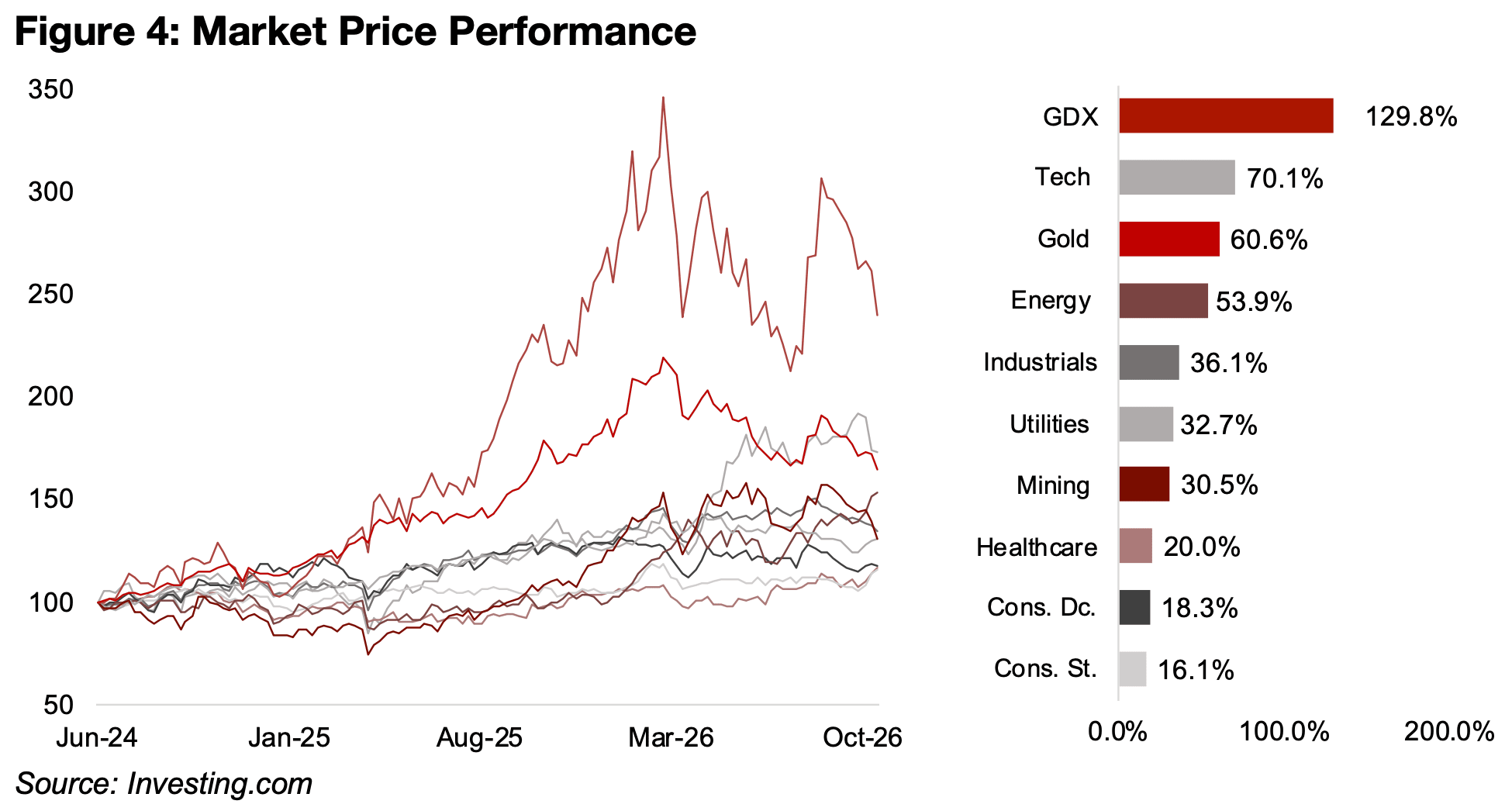
for divestment, especially given the cooldown in the sector this year. The GDX ETF
of gold producers has gained 129.8% since mid-2024 (and was up around 200% as
recently as September 2026) and the metal is still up 60.6% since June 2024 (Figure
4). This has far outperformed all the major global sectors, and the other defensive
sectors have been extremely muted, with utilities, healthcare and consumer staples,
up just 32.7%, 20.0% and 16.1% since mid-2024. Even the tech sector, up 70.1%
since mid-2024, has significantly lagged the gold sector boom.
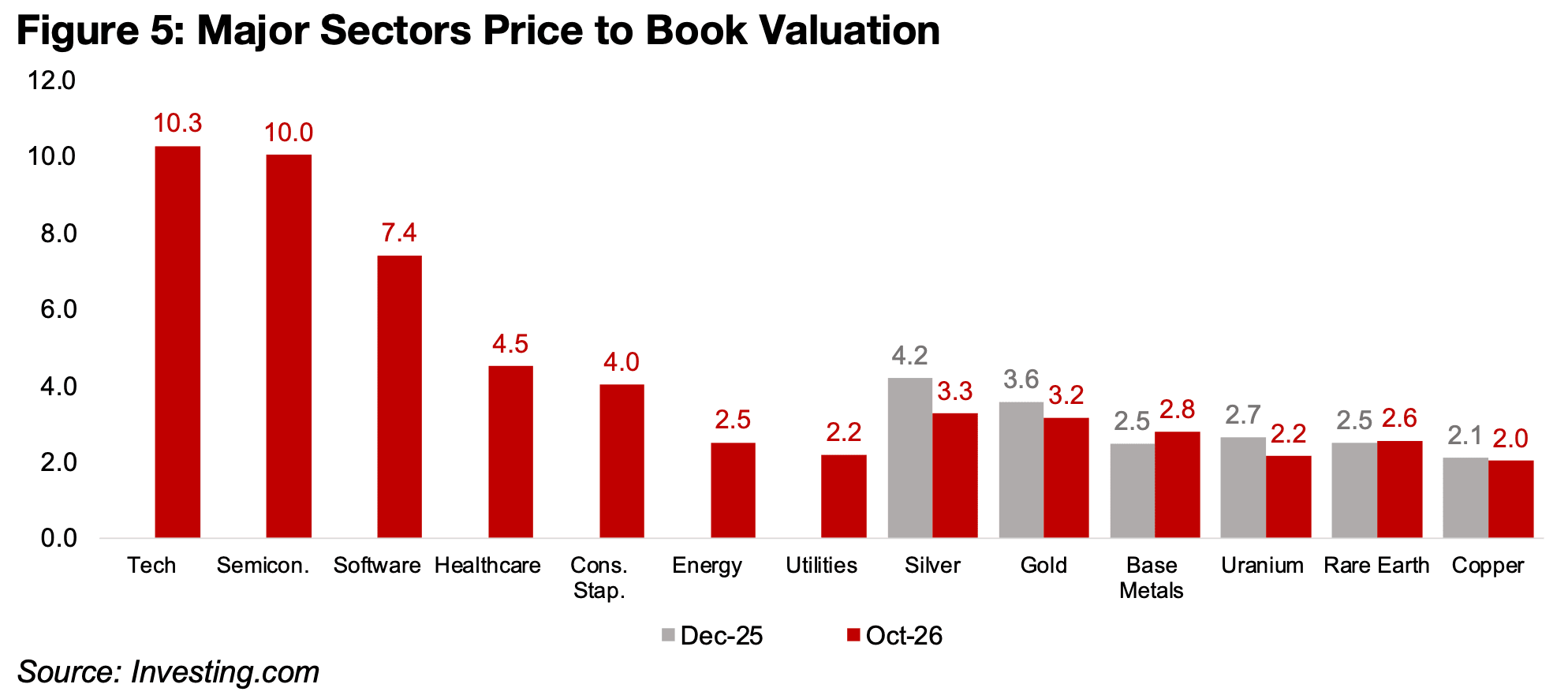
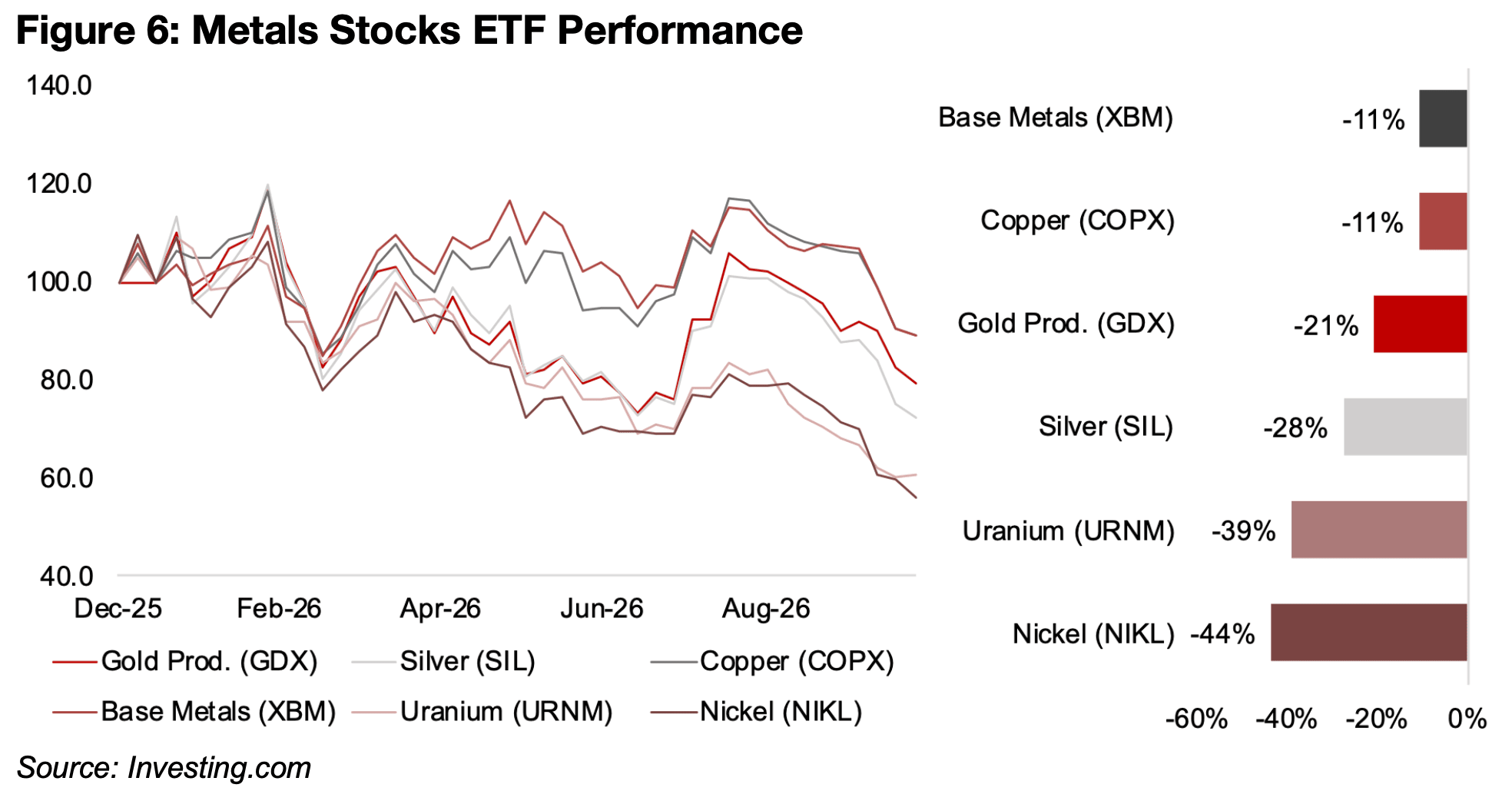
The tech sector could continue to come down further if we assume that its valuations will converge towards other major global sectors, with the global tech, semiconductors and software price to book valuations at 10.3x, 10.0x and 7.4x (Figure 5). This is far ahead of the healthcare, consumer staples, utilities sectors at just 4.5x, 4.0x and 2.2x, and suggests that there may be room for the rotation to defensives to continue on a valuation basis, and even energy trades at just 2.5x after its major jump this year. The multiples for the major mining sectors all remain far below the levels for tech, and even the major defensives sectors, ranging from 2.0x3.0x after declining since the end of 2025. The gold sector has also not been the only mining segment to see a difficult October 2026, with all of the major ETFs declining significantly (Figure 6).
Further evidence that suggests the continued gold sell off may be more of a strategic
move by funds than reflecting a specifically bearish stance on the sector by the
market overall is how orderly it has been, which is shown by the ratio of the change
in gold stock prices versus the metal price. Gold stocks have significant operating
leverage, with costs relatively fixed short-term, and their prices tend to move at a
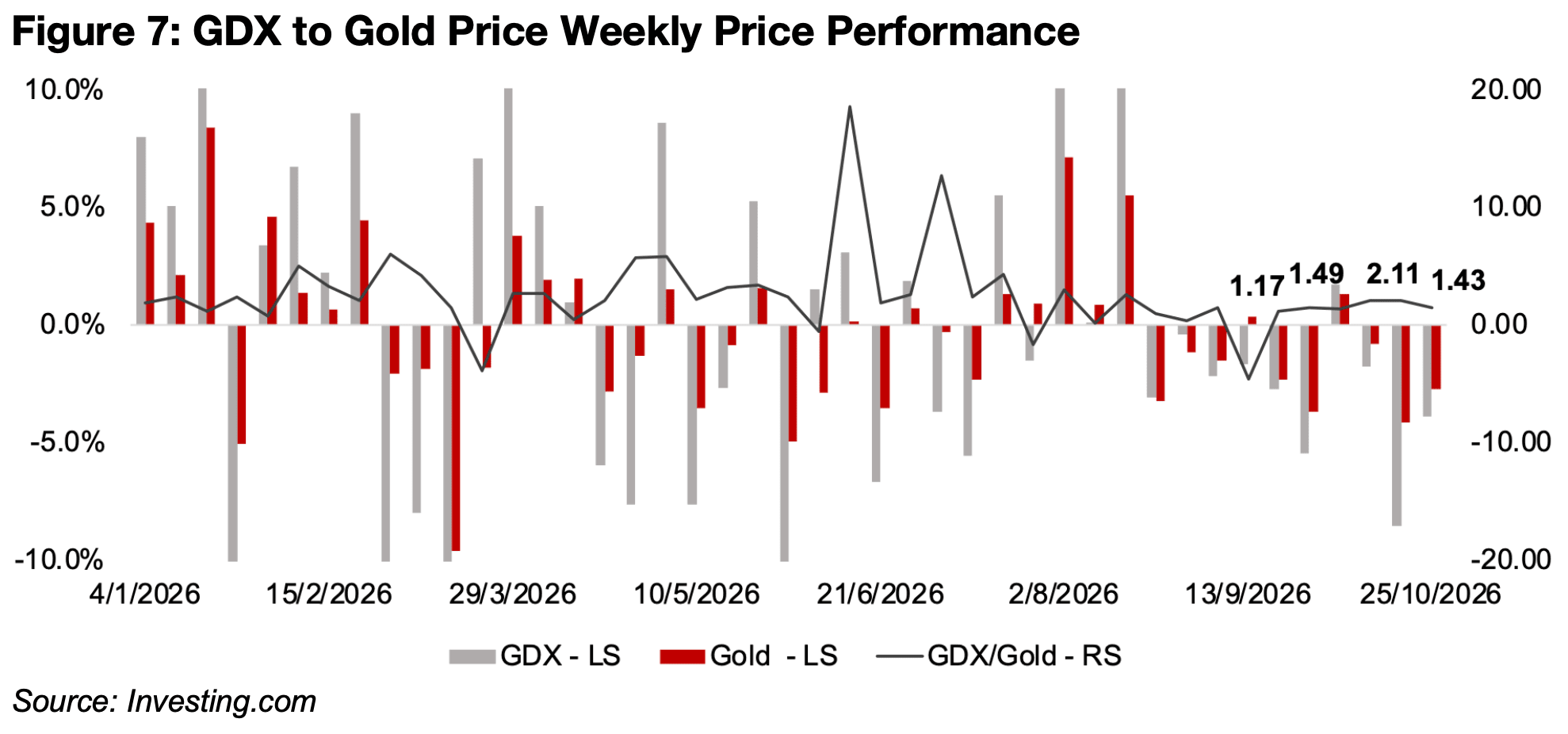
multiple of the underlying metal price. While this ratio has extreme swings short-term,
the long-term weekly average from 2006-2026 is 1.36x. Even if we remove major
outliers, which mainly occur when the ratio spikes because the change in gold is near
zero, it only declines marginally to 1.29%, indicating that on average, stocks in the
sector move about 30% more than the change in the metal price.
While the average in 2026 has been relatively high at 2.46x, removing the major
outliers it declines to just 1.54x, only moderately above the long-term average (Figure
7). Most of the major swings in the ratio this year occurred through to June 2026, and
it has actually become remarkably steady for the past six weeks and quite close to
the long-term average. This does not seem to indicate major distortions in the sector
between stocks and metal price movements, and the declines of the past three weeks
in gold have not been historically severe in percentage terms.
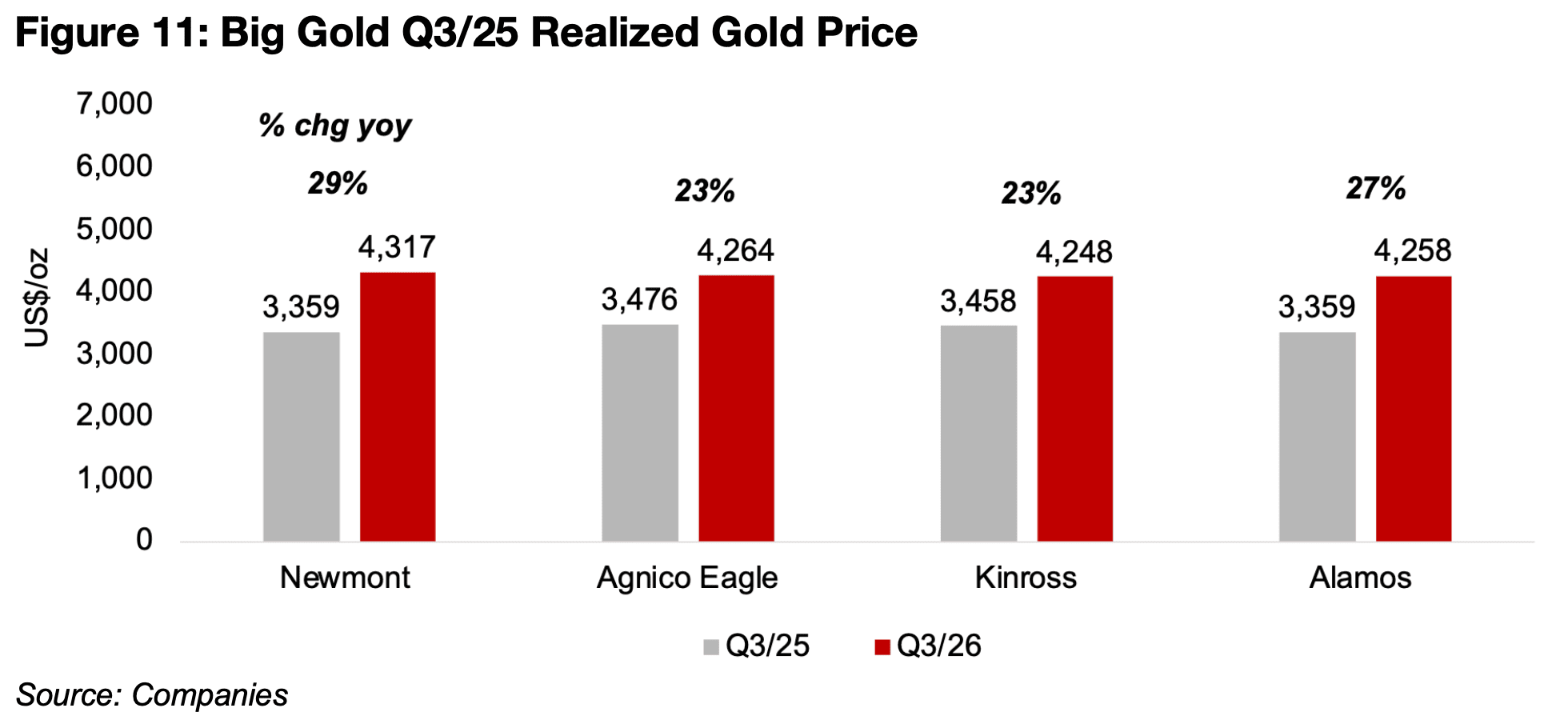
While gold has declined, levels averaging around US$4,000/oz continue to be more
than enough for strong profitability in the sector, with the realized prices for the Big
Gold companies at around US$4,200/oz-US$4,300/oz so far in their Q3/26 results
and still driving wide margins. This week Agnico Eagle, Kinross and Alamos all
reported Q3/26, following Newmont last week, with most of the rest of the majors
releasing results over the next two weeks.
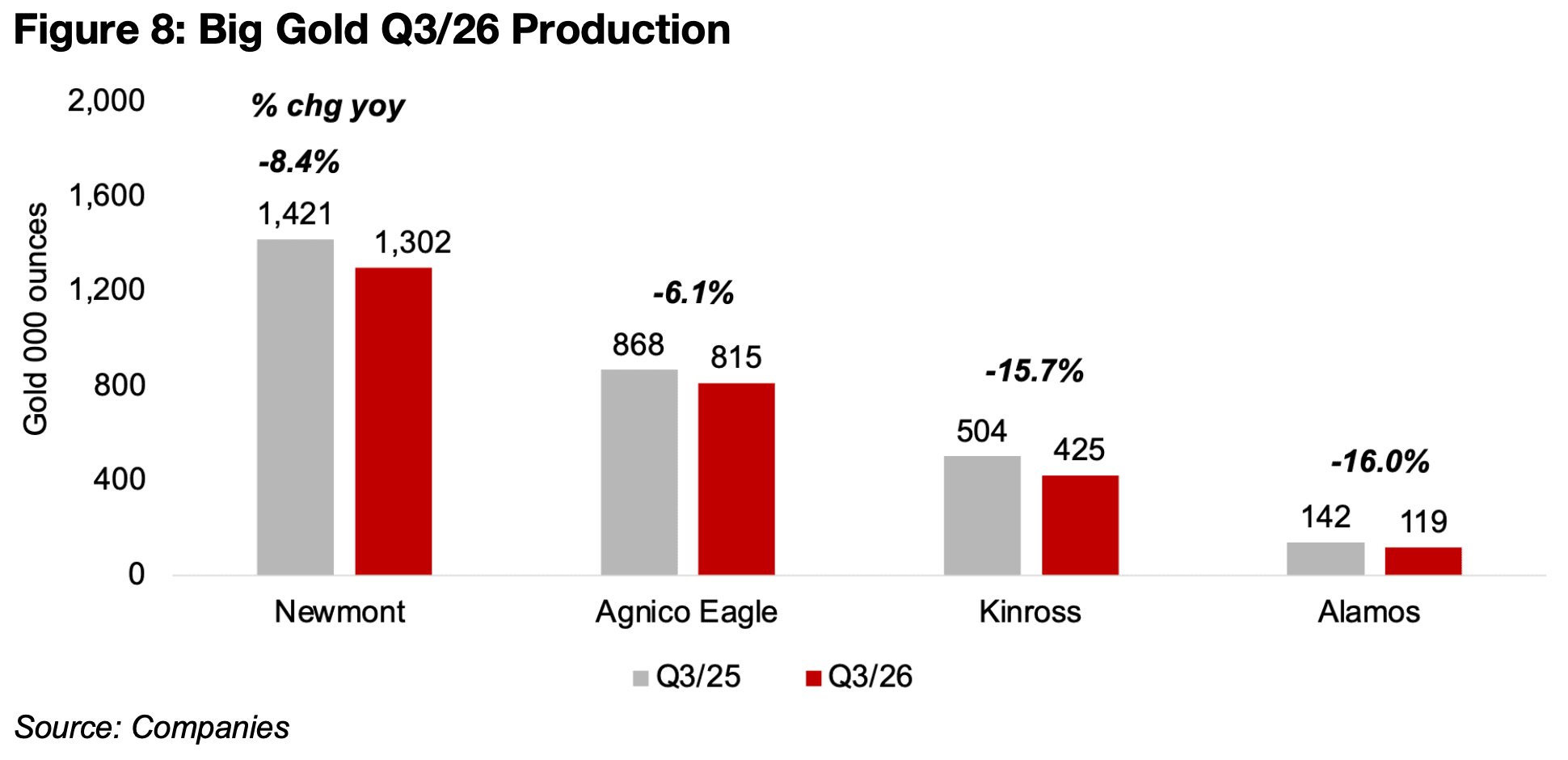
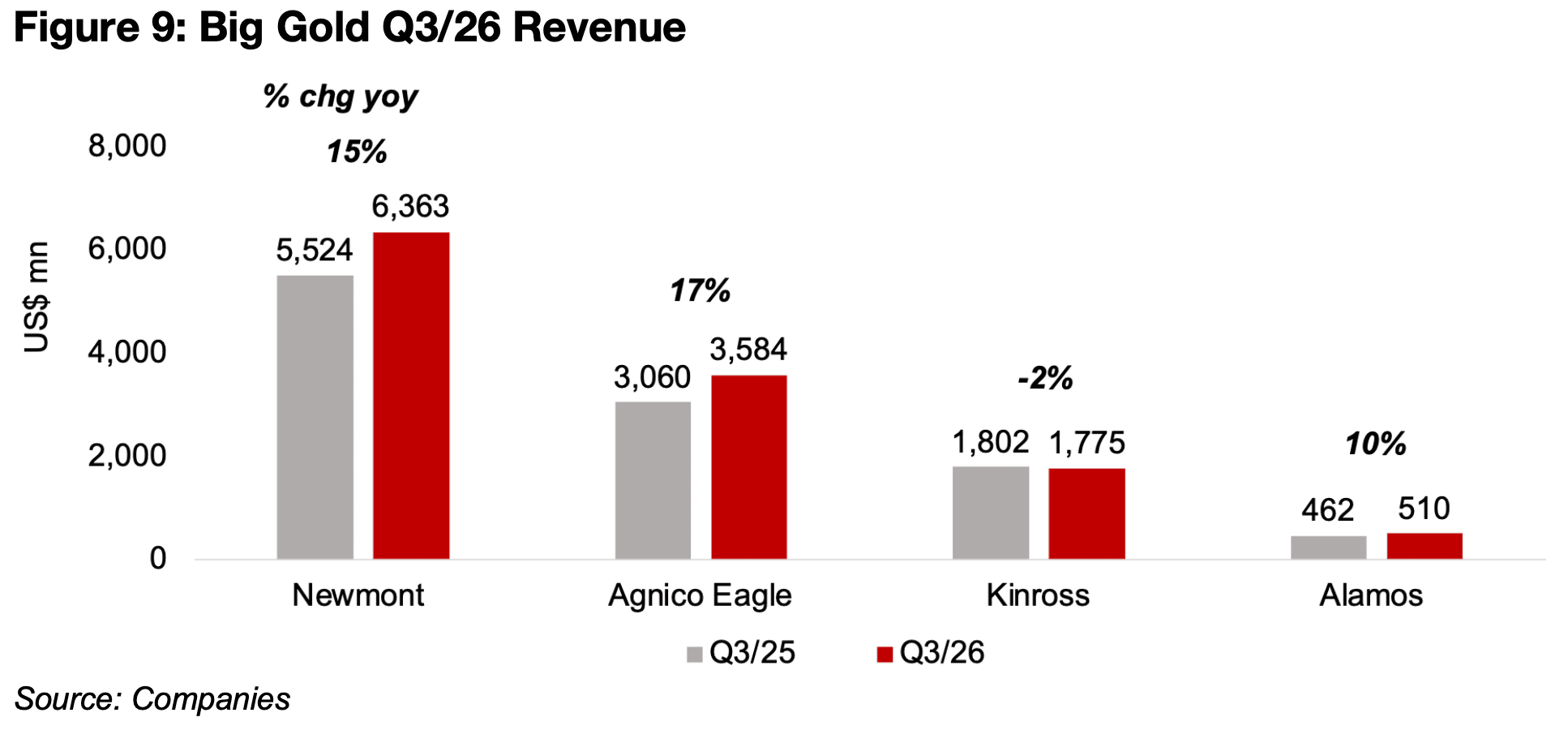
Production declines continued, ranging from -8.4% to -16.0% year on year (Figure
8). While there was still strong revenue growth for three companies as this was offset
by the rise in the realized gold price yoy, Kinross did see a -2% decline (Figure 9).
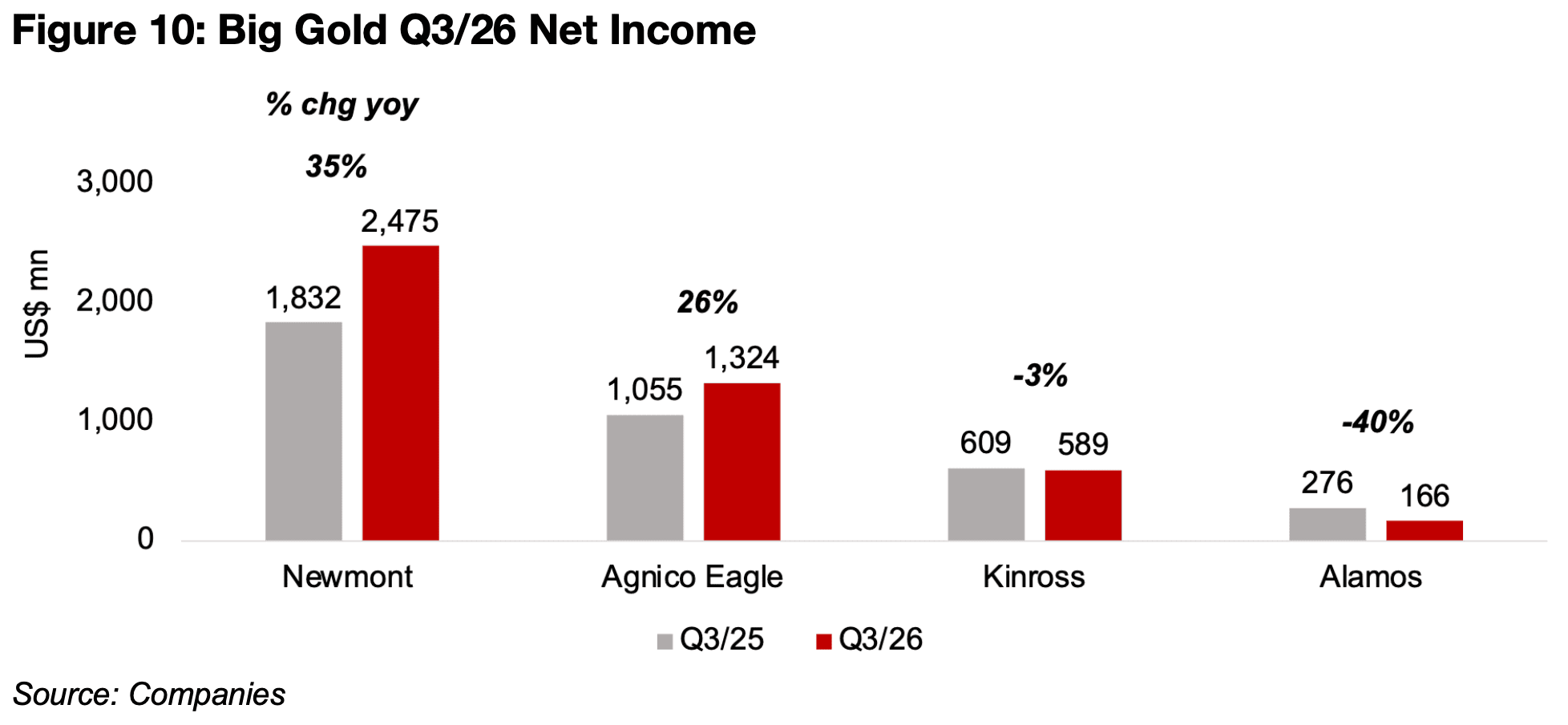
While the rise in revenue translated to a large increase in net income for Newmont
and Agnico Eagle, Alamos still saw a major decline, and Kinross was down given the
low revenue growth (Figure 10). The realized gold price for all the companies
increased substantially yoy ranging from 23%-27%, although this has declined from
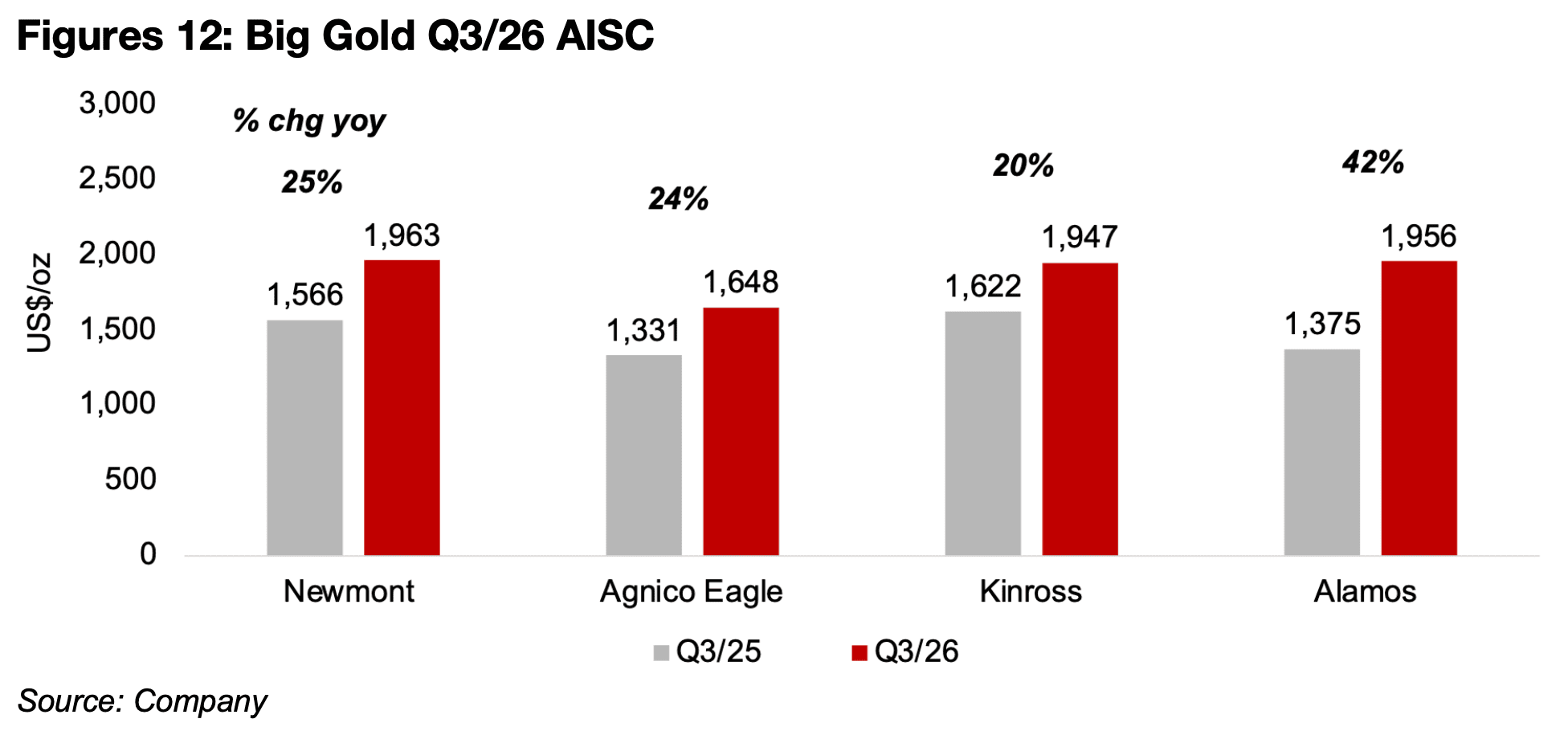
its peak in Q1/26 (Figure 11). There has been rising pressure on income from costs,
with the AISC up substantially for all four companies, ranging from 20%-42% (Figure
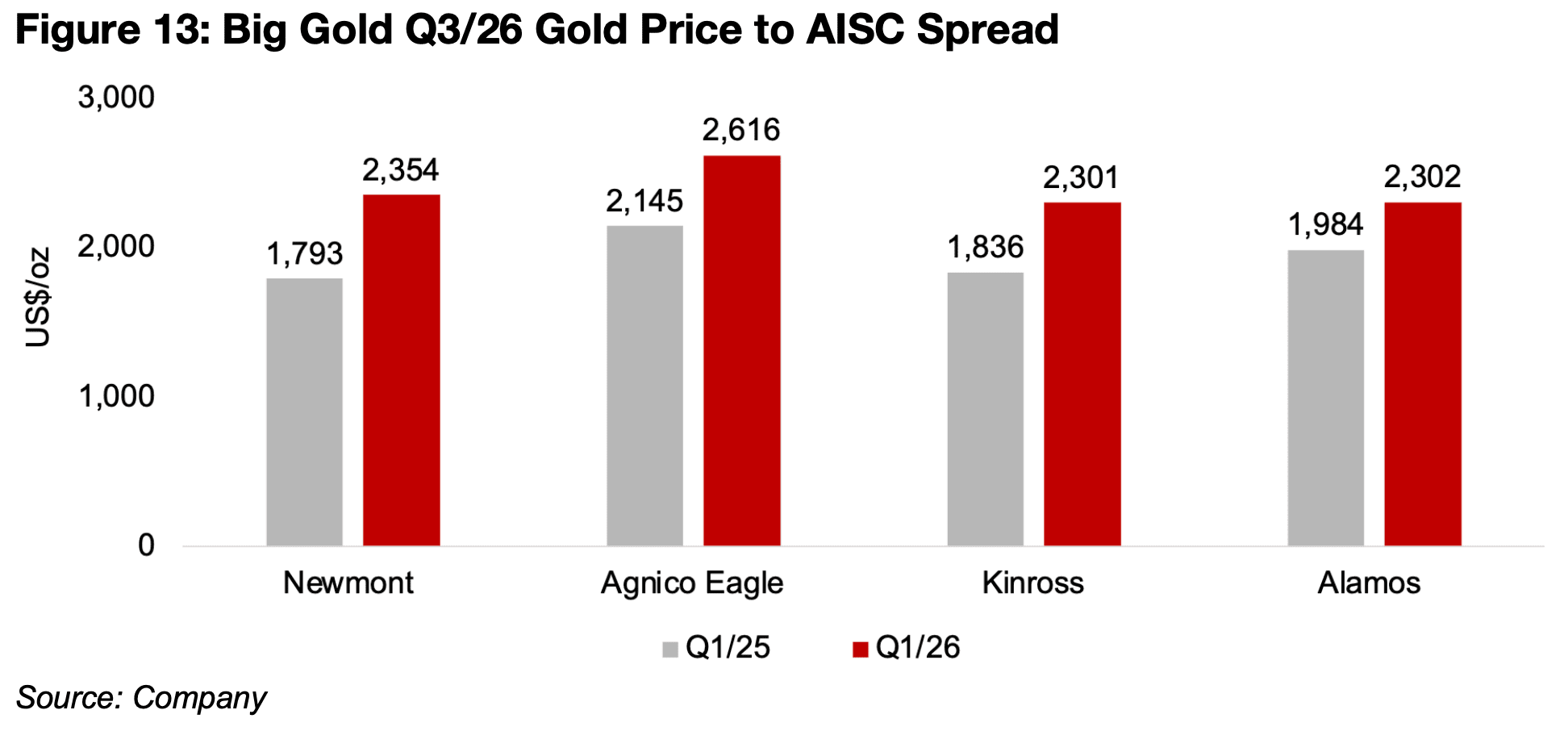
12). However, this has still been far outpaced by the rise in gold, with the realized
gold price to AISC spread at around US$2,300/oz for Newmont, Kinross and Alamos,
with Agnico Eagle the major stand out at US$2,600/oz (Figure 13).
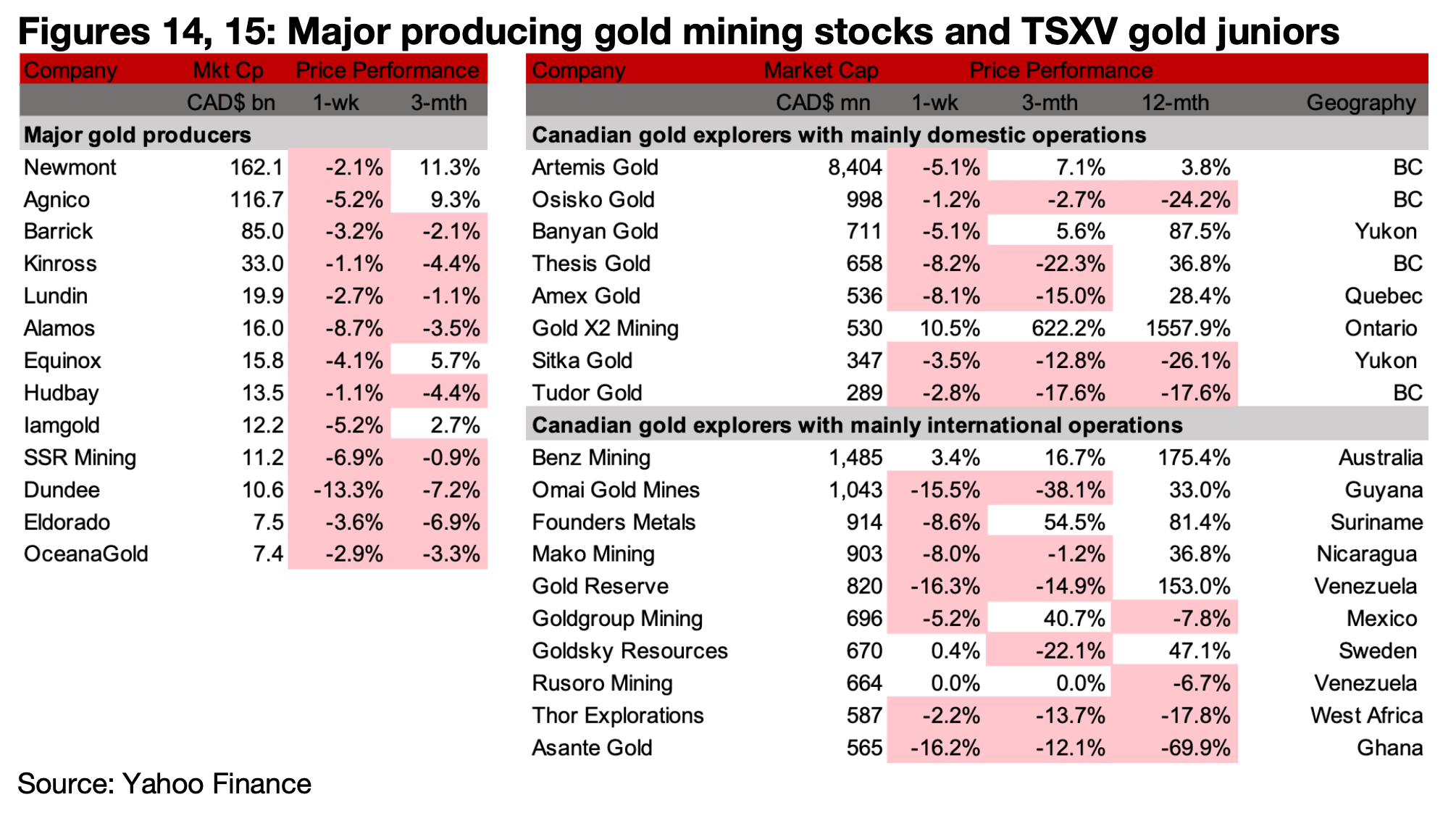
All the major producers and most of large TSXV gold dropped on the continued
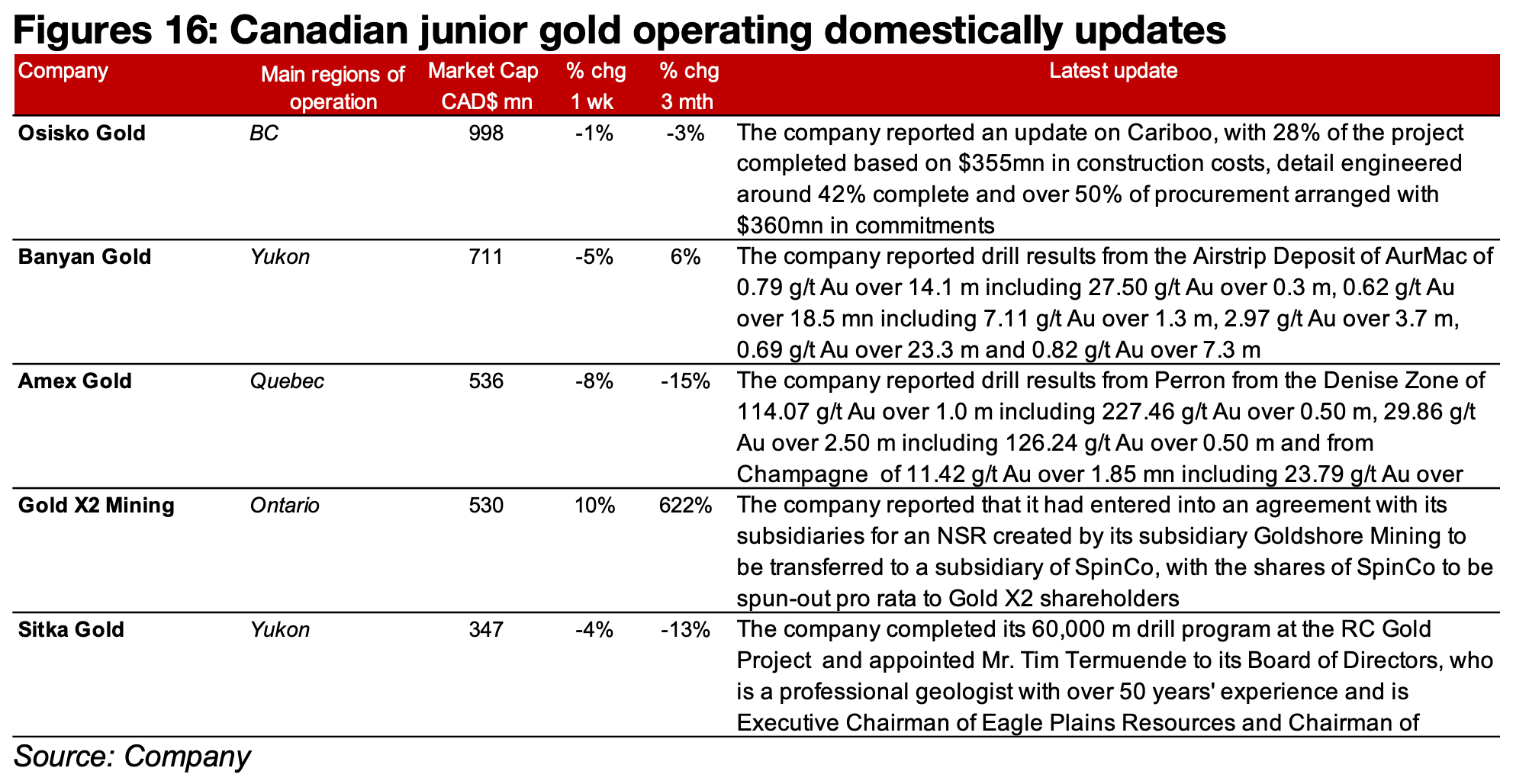
decline in the metal price (Figures 14, 15). For the TSXV gold companies operating
mainly domestically, Osisko reported an update on construction progress at the
Cariboo project, Banyan Gold reported drill results from the Airstrip Deposit of
AurMac and Amex Gold released drill results from the Denise and Champagne zones
of Perron (Figure 16).
Gold X2 announced an agreement with its subsidiaries for an NSR created by its
subsidiary Goldshore Mining to be transferred to a subsidiary of Spinco, and then
shares of Spinco spunout to Gold X2 shareholders. Sitka completed its 60k m drill
program at RC Gold and appointed Mr. Tim Termuende to its Board of Directors. For
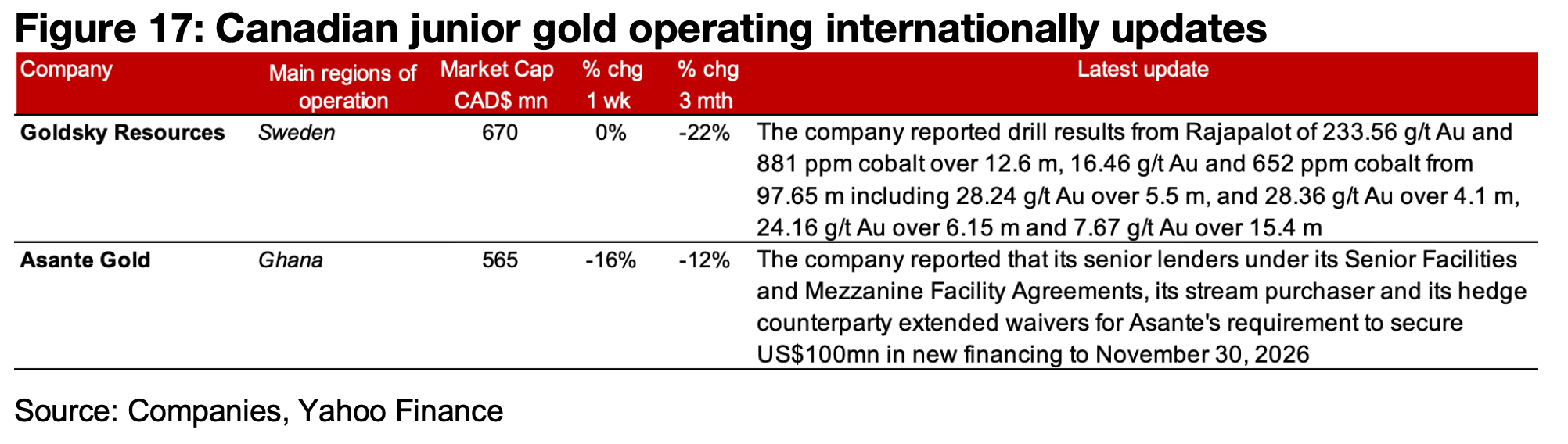
the companies operating mainly internationally, Goldsky reported drill results from
Rajapalot and Asante Gold reported that its senior lenders, its stream purchaser and
its hedge counterparty had extended waivers to November 30, 2026 from October
31, 2026 previously (Figure 17).
Disclaimer: This report is for informational use only and should not be used an alternative to the financial and legal advice of a qualified professional in business planning and investment. We do not represent that forecasts in this report will lead to a specific outcome or result, and are not liable in the event of any business action taken in whole or in part as a result of the contents of this report.
Author
Ben McGregor authors the Weekly Roundup at CanadianMiningReport.com, providing sharp analysis of the metals and mining sector. With a talent for spotting trends, Ben distills complex market shifts into clear, engaging insights on TSXV junior miners. His weekly updates cover gold, copper, uranium, and more, blending data-driven perspectives with a knack for identifying opportunities. A vital resource for investors, Ben’s work navigates the dynamic junior mining landscape with precision.